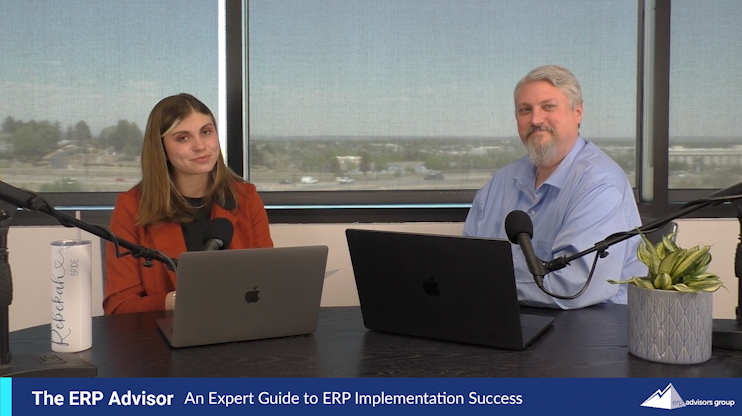
Introduction: This is the ERP Advisor. Today's episode, Selecting the Right HCM Solution for Your Organization.
Rebekah McCabe: Hello everyone. Thank you so much for joining us for today's webinar, selecting the right HCM solution for your organization. Carly Shube is our speaker for today. Carly is a consulting manager at ERP Advisors Group, helping our clients through the entire life cycle of their ERP and other enterprise projects. from needs assessment to go live and beyond. In her time at EAG, Carly has been involved in well over 200 projects, contributing to the successful ERP selection and software selection of over 80 organizations and growing. Her expertise extends across many industries and products, and she's excited to share her thoughts with us today. On today's call, we will dive deep into the world of HCM and how to set yourself up for success with your new software solution. Welcome, Carly.
Carly Shube: Hi Rebekah, great to be here.
Rebekah McCabe: Yes, thank you so much for joining us. I know it can be difficult in your busy schedule with all your demos and helping so many of our clients to make time to do this. So we appreciate it for sure.
Carly Shube: Yeah.
Rebekah McCabe: Awesome. So you are kind of our resident HCM queen. You know a lot about the products. And I think this was a really important topic for us to cover because there are so many organizations out there who look to us for ERP help that don't necessarily realize we do a lot more than that. We also help with other enterprise solutions. And just to start the call, I think it's helpful to lay the groundwork of what is HCM.
Carly Shube: Yeah, so HCM stands for Human Capital Management. What does that mean? That's HR and payroll processes and functionality within a system. And that can be as small as a sub-function of the employee lifecycle or the entirety end-to-end employee lifecycle processes, including payroll processing.
Rebekah McCabe: Awesome. And just to start us off, what are some of the benefits of having these kind of software solutions in your organization?
Carly Shube: Yeah, so you have people. That's what an organization is. It's made-up of 1 or many people. And you need to manage those people. And how do you do so in an effective, efficient manner? And how do you do it with standardizations and in compliance and all of those things that the HR world has to deal with? And you do so by managing with a system in place to help you put together those processes, those functionality that you're looking for to more effectively manage your team. So whether your team is all in one office or is spread across the world, the systems will help you get there.
Rebekah McCabe: Yeah, wonderful. And I know from an HCM perspective, we talk to prospects every day, we talk to clients. There's so much out there for varying sizes, different tiers, different functionality. I would love to get to kind of a crash course on some of the terms people might hear during this call and then the differentiators between those solutions.
Carly Shube: Okay, so the first is to start off with HCM versus HRIS. And what does that mean? So HRIS is a human resource information system and HCM, human capital management. They are different, but really is ultimately the same thing. And it usually comes down to what does the client use for their vernacular? Is it HCM? Is it HRIS? Is it HRS? So it's really just going, what is the client's usage or term and then helping them stay along with that because ultimately what they're looking for is more important than what they call the system. And some other terminology that you hear in the HCM or human capital management world is ATS, applicant tracking system, LMS, learning management system, time tracking, payroll, and then compliance tracking, all of those things that you would, that have a dual meaning from a software and process perspective.
Rebekah McCabe: Yeah, and each of those, like we were just talking about, serve different needs, right? Like there, are there situations in which someone would have all of these and are there situations in which someone might have one or two of these things that you just mentioned?
Carly Shube: So clients, depending on their size and their desire and depth of desire around any one of these particular functions, will use an all-in-one solution that kind of does it all, or will take a system and kind of bifurcate out those processes, those functions into more best of breed or a hybrid style, because maybe they have really complex time tracking needs or they have very specific payroll needs that can't be met with a generic off-the-shelf, although they're pretty much managing that now, system. Or do we need to go towards a more best of breed for learning management or applicant tracking? Some of those things are all, it's all just really also dependent on your preference. And it can be dependent upon your admin, your end users, your HR and payroll users that are doing the work. Or is it, are you marketing or targeting your team, like your middle management team that's reviewing these items, looking for a system that manages to their technical acumen? Or are we going all the way down to our end users who are entering their time? So there's different, levels and needs based upon that. You'll also see a time, for example, that if you have a very global company, that maybe the preference here in the US is vendor X, but they don't have a presence in South America or is not really the preference for the team that's down there. So they'll use, say, like an ADP or in Germany, they love success, SAP SuccessFactors or Ceridian Day Force or one of the pays of the world, paylocity, paycom, paycore, right? All of those have personalities. And if you are a global organization, sometimes you have to work with different systems for those different geos, those different locations.
Rebekah McCabe: Yeah, wonderful. And very similar to what we do every day with ERPs, there's a level of determining readiness for upgrading to a system like that, whether it be, is there actually a need for it? Is the team ready to do that? Is there something else or a different like level that you could be taking walk, crawl, walk, run approach as opposed to just big bang jumping into something? How do you go about determining HCM readiness with our clients?
Carly Shube: Yeah, so a lot of times the clients are like, they know already, but we have to go, okay. It's not about do we change or not, it's how we change and then how do we introduce it to the larger team? So again, it could be around maybe our end users, kind of those who check clocking in and out, need more support and need more training or is it the managers, right? They can sometimes be the forgotten group. Oh, we have to train our admin and our payroll processors. Like they're in it all day, every day. But oh, we forgot we have this whole manager group that is reviewing time sheets, reviewing time requests. hiring new people, requesting new hires, all of that has to go, oh, maybe we need to manage to that. We need to figure out how to roll it out to them. Do we do the whole organization or do we do it by geos or something like that? So it's all about It's such a rote answer being like, it depends, but it does. It depends because you have to think with what are your needs? What are your specific things that we want? Can we start with some of the HR employee lifecycle functions, then move into payroll after the fact because payroll is super complex or vice versa? You know, some of those things matter because you have to look upon what's the team's capability to handle the software in a way that's not going to overburden them.
Rebekah McCabe: Yeah. And something you and I originally didn't talk about, but you kind of raised while you were discussing it, and it popped up as a question for me, is how does industry play into HCM solutions? Or how does it play into the payroll solutions that customers are evaluating?
Carly Shube: A good example would be, say, construction. They have very specific payroll requirements, Davis-Bacon. Just different types of requirements that they have in order to meet those unions, non-unions, how do they, different pay structures sometimes that construction has versus say the hourly manufacturing folks. You know, they, where the typical overtime is the typical overtime, but it's very interesting. I recently had a client that had people in Hawaii where that it just kind of Hawaii's relaxed atmosphere, they really wanted to encourage people to work at least six hours a day. And how do you incentivize somebody to do that? Well, they would say, okay, if you work six hours a day, we'll pay you for eight. And so it's going like, we're incentivizing a full day's worth of work based upon the specific location. That's also a key differentiator. I want to go work for that company versus this one because they really know the culture here. So in that, again, you have to think about that if you were to look at different countries, Latin America or I like to go back to Germany because people like, they like SAP. They do have other ones. I'm not saying that it's the only one. But, they like certain things based upon culture and locations and by the way, in California and all of the complexities around overtime and breaks and making sure the systems are configured for that. So that's how industry can play in. I use, yes, I use construction as an example, but there are other examples too, nonprofits, volunteers. Do you, does the software charge on a traditional PEPM per employee per month fee or is it per employee per check? Well, if you're only paying your employees once a month, that might be more advantageous from a cost perspective to utilize that model versus a per employee per month or vice versa. Do you pay your people every week and you have rolling payrolls and so you're doing a lot of paychecks and you know, those kind of things matter because when you issue more checks, you pay more on that secondary model.
Rebekah McCabe: And I think, so many things. I think HCM more than any of the other solutions that we evaluate, culture plays such a huge role. It is people oriented. Like you have the big guys like Workday, that that's their whole approach is it's about people. And so in those kind of cultures, it can be easy to kind of get sucked into, well, everybody uses this solution. Well, everybody's doing this. Like we should keep doing that. Or sometimes it can be easy to be like, our competitors have a full-scale HCM, so we should have a full-scale HCM. When in reality, when you do an evaluation, going back to what you said about needs, like you do just need payroll or you do just need like a new learning management system because that's going to solve the problems that you have and putting some colossal tool in there isn't going to fix the cultural issues or the people issues that you're having, which is why our needs analysis are so important and going in and working with the client and understanding them is so important. But that kind of leads into our next question, which you and I talked pretty deeply about, was what features should project sponsors use to evaluate HCM solutions at a high level?
Carly Shube: You want to look for the functions that are going to be very unique and specific to you. Yes, of course, if you're located in California, you need to make sure that they understand California compliance for payroll processing. They're all going to understand that. That's kind of known in the market. So what do you do that's unique? You have volunteer management that you need in the system. Do they even do that? Do they not? You have... have specific payroll requirements. You have a very specific prescribed applicant tracking process and vetting process that you need to because you're in some highly classified industry, right? You have to understand everybody has people and everybody has HR processes. So what are the outliers in terms of your functions? Is it a function? Or is it a personality or is it a skill set that brings it differently for you and your organization? And then deeply vet that. Should you of course look at... all of it, the front to end, the soup to nuts, so to speak. Yes, because you want to understand it, but you don't need to spend two hours doing something that that is more routine. You want to spend that time focusing on the specific things that are that you need and want so that the demonstration, the selection process, the evaluation is more fruitful for you.
Rebekah McCabe: Yeah, absolutely. And there's someone else that you talked about that I really like latched on to when we were preparing for this call was the idea of these key groups that you're targeting to and working with them in order to work through the ERP or the ERP, the HCM selection. How do those key groups play and how involved should they be in your HCM selection?
Carly Shube: Yeah, I think it's you, they do, there's the selection and while that is like keeping them in mind, and then it's also the implementation. So for example, if you have a set of kind of managers that are going to be doing reviewing time sheets, payroll stuff, hiring requests, things like that, you want to include a couple of people that are going to be a really good representation for that group, that are also going to be a bit champions. You don't want to pick somebody that's just going to hate it always because then you're not going anywhere, but you want them to be involved. Is it your end users for time tracking? Probably not in the demo. You want to have maybe like those managers say, okay, what are your people? Like, look at this from your people perspective. They have to clock in. Are they going to understand how to clock in? Are they going to like the clock in process? Is the time tracking or what does it look like on the employee portal? Do they have access? How much the pay cards that a lot of these HCM select vendors offer, does it cost them money to use it or not? And do they have direct access to the pay card support? Or is it truly like, hey, our back-end people just really need to assess this? Now, I do think your back-end people need to be in the demonstration, in the selection, evaluation process start to finish, they need to understand that. Because ultimately, who do people call from the organization when they have a problem with their payroll? They don't call the pay card company. They call HR and say, hey, payroll, my check is $0.02 off. Why? They're going to call you. They're not going to call them. So they have to be there from start to finish to really understand that. How do I navigate my employee portal? Those things matter. I'd also say during the implementation process, making sure you're leveraging documentation, training documentation, that's going to be easy for the end users to understand and receive and just go back to and refresh because yeah, during training, they totally understood how to take request to vacation, but six months from now, are they going to remember when they actually go to do it? Those things matter.
Rebekah McCabe: Yeah. And that's leading us kind of into even more, kind of my favorite part when you and I were discussing this, like nerding out on software and talking about some of these things that people really care about. You had some really great key tips for vetting HCM vendors and some things that go beyond just the software. And I would love to dive into that and kind of summarize. I think we're going to give people kind of a quick call today, which is great, bite size, but love to get into that.
Carly Shube: Size of the software vendor, you know, if you there's you don't want to go too small because it'll you tend to you'll grow out of it too quickly. You don't want to go too large because you'll be just another client of them. What personality do they have? Do you want to go with a more white glove approach with like the workdays of the world where like it just you, the people like feel good using the system. Do you want a more functional one in the mid-market space? Then go with one of the pays. Do you really have complex payroll requirements? Then you should look at ADP. You should look at those bigger systems. If you have bigger, more complex requirements, make sure you're looking at that. I'd also say, hey, it's amazing that what's going on, going all the way back to AI again, because everybody wants to know about it, is how are they leveraging AI in their system to help? Now, it's not a magic bullet. It's not a snap of the finger and everything is done for you. But how is it making it better? How is the language? Do you have multiple languages in the system? We're becoming more and more global as a businesses are getting bigger and bigger and they have more and more languages that they have to account for. It also comes down to the relationship that you are going to have with the implementation partner and or software vendor. Do you get along? Does it make sense? Does it feel like the right fit? HR and payroll is the one world in which feelings matter a little bit more than pure function. Functionality absolutely is first and foremost, but the look, the feel, the comfort is there because it is around human resource management, right? So you're managing the people. It's what do my people want to be in? What are they going to like not hate at the end of the day that they're like, oh, I hate this app. I can never figure out how to request time off, whatever it might be for them.
Rebekah McCabe: Yeah. And something really important that you said previously that we talked about during prep was about that woo that software vendors have for HCM. They're going to, they want to meet in person. They want to come to you. They want to bring you things. They want to have lunch. They really want to make that personal connection with you. But you specified just how important it was, too, to not be charmed, like beyond that. So I'd love for you to just talk about that a little bit as well.
Carly Shube: Yeah, HCM vendors and sales reps are, still, they still take on that personal approach. Not that other software vendors don't do that. They just take it, I think they just take it a notch up, and they want to create that relationship because they know that's the human capital, that's the relationship building that they do. So don't let them charm you because they brought you a box of donuts or they brought lunch or they brought coffee to everybody to say hi. That is part of the approach. And it's great because you're building that relationship. But at the end of the day, the sales rep goes away. So you want to build that relationship with the technical resources, the people that on the back end that are going to help you through the implementation and help you in the long run. Let them charm you. That is part of the approach of finding the right software. Is it too much or too little? Like what is that? And then going from there and saying, okay, great, like, I like this, but maybe that was coming on too strong, or, hey, I want to work with you. This is the problem that I'm seeing with your presentation, you're not hitting this requirement. They're going to go the extra mile. And it's, you know, all vendors will, you know, go and go hard. The HCM vendors like really go the extra mile when you create that relationship to help you. They want to make sure you're getting what you need and want out of the system. And they're creating that long-term relationship because gosh, golly, you really don't want to change for several years, you know, 5, 7, 10 years out. Now, if you 100x and you need to change, I'm all for it. That is like the best reason to change is because you've outgrown something so exponentially, but you don't want to have to do it because we didn't think about blah.
Rebekah McCabe: Yeah. And is it, speaking of that customization and getting what you want out of the system, how similar are HCM ecosystems to ERP? Are there partners? Are there people that'll deliver specialized customizations or a very specialized approach to what you need?
Carly Shube: Yes and no. A lot of the HCM vendors out there will self-implement, but that doesn't mean that there aren't partners in the ecosystem. that expand upon those functions or do the actual implementation because they can take a either more white glove or less white glove or a faster approach or whatever that might be to tailor the implementation to you. They also can be your support system, whether it's, hey, my one and only payroll person is going on maternity leave and I need to backfill them or maybe we need just a little bit of support while we look for the second payroll person, but whatever those things might be, there are partners out there. And then in terms of functionality extensions, there are partners and applications out there that have extended upon the software. It's not as... in such volume as say ERPs, but they do have them out there. And it is important to know that if you have something that's really complex and really, really nuanced, that they do have the functionality that you would, that they have somebody that can probably build something or have built something.
Rebekah McCabe: Yeah. And Carly, you've shared so much great information with us today, and I think it was very helpful. I don't think many businesses realize just how much goes into these processes, and we don't talk about it enough, that there are obstacles and there are things that you're going to have to confront during that. So just kind of in summary, I hope that everybody got what they needed out of this call. And if you have any questions, please let us know. But just know that you don't have to do it alone. If you are taking on an HCM selection or you're trying to get a new payroll solution or anything beyond that, all of the above, we are here to help. And Carly has a great team that is more than happy to answer any of your questions. And thank you again for joining us today, Carly. Do you have any other parting words of wisdom you would like to share with the group?
Carly Shube: I guess I would say is simply function first, woo second, and ERP always. E-A-G always. But really, if you need help, whether it's just a simple phone call, kind of one and done, that's great. If you want in-depth help, we're here to help you. But recognize there are a lot of people out there that want to help you be successful, and it's totally okay to lean on some people.
Rebekah McCabe: Wonderful. Thank you, Carly. And thank you everyone again for joining us for today's webinar. Be sure to join us for our next webinar, which is scheduled for Thursday, May 14th, An Expert Guide to ERP Implementation Success, where Quentin DeWitt, Principal of Consulting at EAG, will break down the best practices for ERP implementation and how you can achieve your ERP goals. Please go to our website, erpadvisorsgroup.com, for more details and to register and to see even more friendly faces from the EAG team. ERP Advisors Group is one of the country's top independent enterprise software advisory firms. EAG advises mid to large-sized businesses on selecting and implementing a wide variety of business applications, from enterprise resource planning, customer relationship management, human capital management, business intelligence, and other enterprise applications, which equate to millions of dollars in software deals each year across many industries. This has been the ERP Advisor. Thank you again for joining us.
Carly Shube: Thank you.



.png)
-1.png)