Selecting a new Enterprise Resource Planning (ERP) system is one of the most important technology decisions a business will make. And, yet, despite the millions of dollars organizations invest in ERP software and implementation services every year, many projects begin with fundamental mistakes that could have been avoided long before a contract is signed.
Selecting a new Enterprise Resource Planning (ERP) system is one of the most important technology decisions a business will make. And, yet, despite the millions of dollars organizations invest in ERP software and implementation services every year, many projects begin with fundamental mistakes that could have been avoided long before a contract is signed.
At ERP Advisors Group, we've guided hundreds of organizations through the complexities of ERP selection across all major industries, including manufacturing, distribution, professional services, construction, retail, nonprofit, and more. While every business has unique requirements, the reasons ERP selection projects fail are remarkably consistent (and avoidable).
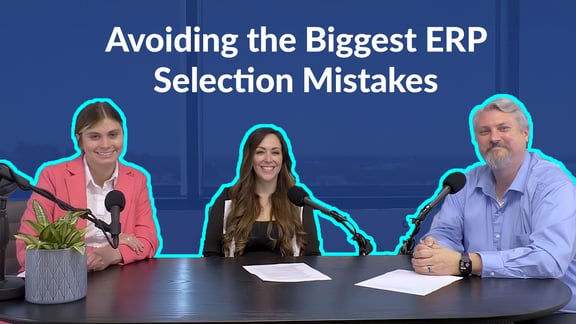
During our recent webinar, Avoiding the Biggest ERP Selection Mistakes, our consultants shared the issues they encounter most frequently during software evaluations and explained how organizations can dramatically improve their chances of selecting the right solution.
Here are the most common mistakes made during ERP selection with ERP Advisors Group’s exclusive tips for achieving success.
Mistake #1: Shopping for Software Before Understanding Your Business’s Needs
Perhaps the most common ERP selection mistake is beginning the software search before fully understanding your organization's own needs.
Often, companies know they have outgrown their existing ERP or believe they need new capabilities to keep up with the competition, like AI, automation, or improved reporting. At that point, many will begin researching vendors or scheduling demonstrations without first documenting the problems they are actually trying to solve.
This approach ultimately results in the vendors defining project success, not your business.
Instead, organizations should begin by developing a clear understanding of:
- Current business processes
- Operational pain points
- Strategic business objectives
- Future growth plans
- User requirements
Business strategy deserves particular attention because you are not only planning for success today, but five, ten, twenty years from now.
For example, if your organization plans to acquire additional companies, expand internationally, double revenue over the next five years, or prepare for private equity investment, those strategic initiatives should heavily influence your ERP selection. A system that works well today may not support where the business intends to go tomorrow.
Likewise, organizations should evaluate whether existing software already includes capabilities they may be underutilizing. Sometimes a business has a very robust system, but they are not taking advantage of additional modules offered by the vendor. Companies often assume the grass is always greener and that they must pursue an entirely new solution when optimization is actually a viable first step.
Mistake #2: Letting Vendors Control the Selection Process
ERP vendors naturally want to demonstrate the strengths of their products and that is not inherently problematic. The issue occurs when organizations allow vendor sales processes to dictate how they evaluate the solution instead of the demonstrations being driven by your business’s needs.
Rather than allowing vendors to determine what they showcase, businesses should establish objective evaluation criteria before any demonstrations occur.
This includes defining:
- Critical business requirements
- Must-have functionality
- Industry-specific processes
- Key use cases
- Success metrics
Once these requirements are documented, vendors should be asked to demonstrate how their software supports those exact scenarios—not simply present polished marketing demonstrations. It is also important to be aware of any areas where the vendor is unable to meet your requirements and determine if said functionality is crucial. Some concerns can be easily mitigated during configuration while others may be unattainable without heavy customization.
Ultimately, this creates a standard for evaluating each vendor and ensures your business sees what you need to during every demo.
Mistake #3: Focusing Only on the Software
ERP selection is not simply about choosing software. It is equally about selecting the right implementation partner and team for the process. In many cases, several ERP solutions may adequately satisfy an organization's requirements, and the largest differentiator is the firm responsible for implementation.
Businesses should ask questions such as:
- Does the implementation team have experience in our industry?
- Have they completed similar projects?
- Will they be a strong long-term partner?
- Do we trust their guidance?
- Are they a good cultural fit?

An ERP implementation often lasts many months and frequently evolves into a multi-year relationship. Therefore, you want to enjoy working with their team! Just as important as software functionality is whether your implementation partner understands your organization, communicates effectively, and can successfully guide change throughout the project.
Mistake #4: Involving the Wrong People
Stakeholder involvement is critical, but more participants does not automatically equate to better decision making or efficiency.
Organizations frequently make one of two mistakes:
- Including everyone too early, creating conflicting opinions that make decision-making difficult.
- Excluding key decision-makers entirely until the final stages.
Successful ERP selections involve stakeholders at the appropriate time and at the appropriate level. However, this is not the easiest thing to juggle or execute.
During the needs assessment phase, your Subject Matter Experts (SMEs) and key end-users should be interviewed and encouraged to share their observations. Ultimately, they are the individuals who have the deepest insights into how they departments operate and will be able to effectively identify bottlenecks.
Early demonstrations should typically include only core business leaders responsible for evaluating functionality. The last thing you want to do is waste resources’ time on unnecessary demonstrations.
As the selection progresses, additional project team members should become involved to validate how the software supports their specific responsibilities. This ensures gaps are not overlooked.
This phased approach helps organizations gather meaningful feedback without overwhelming the selection process. Just as importantly, executive sponsorship must exist from the beginning. If executive leadership has not committed to the initiative, even a successful software evaluation can ultimately fail when final approval is required.
Mistake #5: Skipping Independent Research
Before contacting software vendors, organizations should spend time understanding the broader ERP marketplace.
Useful research sources include:
- Industry peers
- Professional networks
- Competitors
- Online communities
- Independent research
- Existing implementation partners
Speaking with organizations that have recently completed ERP projects often provides practical insights that marketing materials cannot. Research also helps narrow the field before demonstrations begin.
With hundreds of ERP platforms available today, attempting to evaluate too many systems quickly becomes overwhelming. Instead, businesses should reduce the list to only those platforms that realistically align with their industry, company size, and business requirements before investing significant time in vendor demonstrations.
Mistake #6: Assuming Instead of Validating
One of the largest risks during ERP selection is assuming functionality exists because it seems logical. As a results, organizations often believe:
- "If the software has procurement, it must also support our planning requirements."
- "If it handles manufacturing, it probably supports our specific production model."
Those assumptions can be extremely costly. Critical functionality should always be demonstrated and validated, not simply discussed. And, while most modern ERP systems provide similar core capabilities, every business has unique processes that differentiate it from competitors. Those differentiators deserve the greatest attention during software evaluation. Trust what you can verify.
ERP Success Begins Long Before Go-Live
Selecting ERP software isn't about identifying the product with the longest feature list or the most polished demonstration. Success comes from understanding your business first, defining objective evaluation criteria, validating critical requirements, involving the right stakeholders, and selecting an implementation partner capable of guiding your organization through change.
Organizations that invest time in preparation make better software decisions and the result is smoother, more successful implementations.
If your business is preparing for an ERP selection, working with an independent advisor can help you evaluate vendors objectively, reduce project risk, and ensure your software investment aligns with both your current operations and long-term business strategy.
At ERP Advisors Group, our consultants have successfully guided hundreds of ERP selections using an independent methodology designed to help organizations confidently choose the right software and partner for their unique needs. Whether you're just beginning your ERP journey or evaluating your final shortlist, independent guidance can help you avoid costly mistakes before they become expensive implementation challenges.

About ERP Advisors Group

ERP Advisors Group only provides software advisory services. Our consultants only work on enterprise software selections and implementations. Therefore, they are experts in conducting software selections and know the pitfalls to avoid as they guide our clients to a successful go-live. You will find our consultants care deeply about your project and are vested as much as you are in making it a success. Ultimately, we will do just about anything to make sure you are a success!
ERP Advisors Group was founded by Shawn Windle in 2010. He helped develop the technology practice at the largest accounting firm in Denver from 2004 - 2010 by offering Needs Analysis and Selection projects. But Shawn saw that clients were struggling during their implementations, even though they selected the right software. The firm’s partners were too averse to the risk of losing tax and audit business from a risky implementation. Thus, ERP Advisors Group was born with the purpose to provide Client-Side Implementation Services.
We take responsibility for the decisions we help our clients make during the Selection phase by staying on for their implementation, ensuring they go live with their new software.
Download our free company brochure for more information about EAG.
.png)
-1.jpg)
.png)