Introduction:
This is the ERP Advisor.
Today's episode, 2026 ERP Trends and Predictions, Part 1.
Rebekah McCabe:
Hello, everyone.
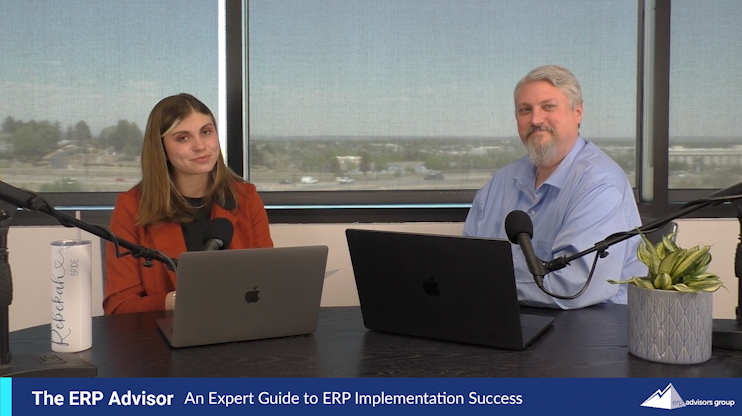
Thank you so much for joining us for today's webinar, 2026 ERP Trends and Predictions, Part 1. This is one of many years that we have been doing this, and I think this is my third year joining Shawn, so I'm really excited, Shawn is one of our speakers for today. Shawn is the founder and managing principal of ERP Advisors Group based in Denver, Colorado.
Shawn has almost 30 years of experience in the enterprise software industry, helping hundreds of clients across many industries with selecting and implementing a wide variety of enterprise solutions.
His podcast, the ERP Advisor, has dozens of episodes; it's probably higher than that, going up all the time, and 10s of thousands of downloads, which is also increasing. And it's featured on prominent podcast platforms such as Apple and Spotify.
And then Rebekah McCabe is our other guest. She's myself. Digital marketing manager for our team here at ERP Advisors Group and host of the wildly successful ERP Minute. Super excited to be joining you again, Shawn. And we're going to talk about some of the hottest, which is funny to use in the software industry, ERP trends for this year, and break down how those trends impacted the world of software in 2025. And this will really set the stage for the call we're going to have tomorrow, which is going to be our predictions, and we're going to go over all the vendors, but no specific vendor talk today.
Shawn Windle:
But before we go any further, I have to expand upon Rebekah's intro. So, Rebekah and the team, but mostly Rebekah leads all of our content creation and research and analysis.
And she talks to many, many vendors each year around what they're actually no kidding doing either with legacy products that they have. And even sometimes we're like, oh, you're going to do blah with that product. And then we put it out online and they call back and they're like, no, you can't say that because of da, da, da reason. And like, okay, fine, even though it was truth. But Rebekah, you've done a phenomenal job.
I mean, especially this year, but even the last couple of years of really digging in and having real information about what's happening. I mean, literally on a minute by minute basis with these vendors. So, I can't thank you enough for that.
But more importantly, I think our clients, especially those that are searching for software, if they're not listening to your ERP minute, they are totally missing out on what's happening in this category. Like you cover it so well. So, thank you for doing that.
Rebekah McCabe:
Thank you, Shawn. I appreciate that a lot.
And I love my role. Can't say that enough that I get to read about all of these things. I get to geek out on software a little bit, and any of our clients who have interacted with me know how excited I get when they ask for downloads or brochures, and I get to be a part of their journey. So, thank you so much for that.
This is one of many years that we've been doing this, and I think people get a lot of value out of this event. I know many of them look forward, especially to the vendor review, where you and I kind of go in depth with each of the vendors and what's going on.
But for today, I kind of want to set the stage on what this year looked like and what a lot of companies, businesses, vendors were doing. And I think towards the beginning of the year, we really saw that boom of AI. And that was a huge trend. And really, it was a buzzword still, to be completely honest, going into 2025, 2024 was setting the stage for some things.
But we weren't really seeing how it was going to apply to businesses. And I think there was still a lot of fear around what the vendor strategies were going to look like, how they were going to apply these really applicably to businesses without it being this huge, hey, you're going to get to fire everybody and robots are going to run your business. Because that's really not what was happening. And it's really still not what's happening. But it really was a little more fear at the beginning of the year, as well as some like economic changes, global changes that led to some things that were making people hesitant to really even make an ERP upgrade, let alone take the plunge into AI, which is kind of unknown territory.
As the year kind of progressed, we saw these tools continue to advance. And we did a leaders in ERP interview where we actually had the vendor say that they were going to start seeing more collaboration between vendors. And that was something that needed to happen in order for AI to continue to expand and grow the way that it needed to. And I think we really did see that. There were plenty of acquisitions that continued. There was lots of private equity going into the software space with, I mean, Acumatica was a huge one. They got acquired this year. They had backing. Some of the smaller solutions were getting acquired across the board and getting pulled into these larger vendors, more industry-specific specialized solutions. And we really saw this boom where lots of the vendors were starting to work together to bring industry-specific solutions beyond AI into the core ERP applications. And customers were starting to benefit from this wave of, hey, best practices mean not necessarily putting all those customizations in.
However, now we have a solution that's native or we're making it native, integrating into the system that you can pull up. Some are native, some are just like third-party connectors, APIs that they're starting to connect a lot better so that companies can benefit from that.
And then even going into the second-half of the year, Shawn, I had the most dystopian experience ever the other day when I went to Wendy's. And I'm sure people are starting to experience that even more was I ordered from an AI agent. There was no person. I was talking to the agent, ordering my food and having to interact with them. And you keep thinking someone else is going to come on the speaker. They didn't. You just ordered everything. And then there was one kid in there managing the whole store by himself. So we're starting to see it come to fruition. And that's probably an extreme example, because that's also the only store I've seen doing that. Plus, it was later in the night. So, they probably do staff more people throughout the day. But we're starting to see these applications, or these tools become applicable in businesses. And they're real.
And it's not, again, it's still not, hey, it's replacing everybody's jobs, but it's really like down to earth solutions of like, hey, I'm automating APAR, like accounts payable, accounts receivable, not just with OCR so that I can scan my document and it goes into the system, but. There's agents now that can kind of look at it and spit back out the information to me so that I can verify it. There's still a human element there, but the tools have gotten a lot more advanced. And so, I think that kind of sets the stage for the conversation we're going to have today, Shawn, and just going into the next question I have for you.
What major trends in ERP did you see emerge in 2025?
Shawn Windle:
Yeah, I think you did a really good kind of a, the folks listening may have to slow down that portion to really understand every single thing you said, but that's all exactly right of what occurred this year. We had a CFO discussion, I think in maybe the fall of 2024 around AI and what to prepare for. And it was a bit of a, well, maybe that really curious person that works for you that's probably, not on the older side, right? Maybe it's time to get them to go start playing around with some of these platforms.
To this year was, okay, you need to understand what your vendors are doing currently around AI and start piloting those solutions. And by the way, you're probably already using some of those, like you said, especially around kind of the repetitive processes like AP. But I think the thing that people listening to this don't realize, and that you really should understand about 2025, is that I think ERP came back to life. So, if you even go a little broader and you look to sort of 2019, growth rates for ERP were starting to slow down a little bit.
And then, of course, during COVID, we had this very unusual time of getting everybody to work from home. And a lot of our clients and many other companies sort of took their apps to the cloud. They had to where they switched over, especially in 2021. When things started to settle down, we saw more migrations to ERP, almost driven from a necessity level, just like, okay, wow, we really have to get into the cloud. As well as 22, 23 were probably the two biggest years that I can remember, or maybe ever, where we heard a lot of cybersecurity attacks, a lot within our customer base, the mid-sized companies. Like it was very real.
I remember one of the years we had four or five clients that had gotten some kind of ransomware, and multiples of them were in the process of implementing their new ERPs. And one of them even just moved up their go-live date and just said, we just don't even want to deal with that old system. Let's just go to the new and just roll with it.
And then in 2024, and even in the beginning of 2025, there was a lot of just sort of socioeconomical, political uncertainties that were going on. But through that whole time frame, what I think the reality was that a lot of the companies that we work with, and even nonprofit organizations, they actually had a really strong cash position. They actually had money, and they wanted to invest in productivity and in viable solutions that would drive the viability for their organizations. But they didn't know what to do. So then, when the AI sort of wave really hit the world, call it a tsunami, say late 24, I mean, I'm in San Francisco right now and there's companies here.
Actually, I think that little white sign is for an AI company. I can't believe the amount of AI advertising that's happening in the city. Every billboard with some AI agent coming into the city from the airport. It's like, OK, I guess that's where your money's going. Private equity is in the billboards, fine.
But in 2024, this AI tsunami really hit hard. And the usual sort of positioning that the enterprise software vendors do started to occur. And when I say usual, it was a, we kind of need a message around what we're doing for used to be cloud or robotic process automation or machine learning, maybe a little less on that, but definitely AI.
So you started hearing all this messaging around, oh, we support AI, we got AI, we got, I mean, even last year at a software vendor conference, and they were showing their AI tools, and it was like, that's it? Like, no, there's got to be more, but that's just where things were at.
So now, I think the vendors have had time to step back. They've had and they've had to make decisions on which platform they were going to build their own sort of ERP vendor specific tool on, whether it was, you know, Anthropic or Gemini or I don't hear too much about Llama with the ERP vendors, Grok, whatever.
And they've made those decisions, and they're like, kind of like, vested in them. So that was a huge change this year, huge. And then also, I think from a customer perspective, that's a little outside the scope of this call, but every prospective client meeting we have, every single one of them, the sponsors and people who are driving these projects are saying, we've got to get an AI strategy in place.
And then they ask us, well, what are you guys doing? Like, what's ERP Advisors Group doing? Which has been a great conversation, which we're really excited about our initiatives there. But, you know, the awareness of AI, of course, is the big thing.
But again, I just really want you all to understand, for those listening to this, is all like funneled and powered from so much capital that's just been sitting on the sidelines, just waiting for something to invest in. And it was AI. So even you talked about the acquisition that Vista made of Acumatica.
Oracle's pouring tons of money into their AI. SAP is doing significant things. I mean, all of them are. But the thing that I really want you to understand is not only are they like, you know, kind of teetering or just playing around or piloting AI, they've made their five-year bet on which AI platform, if not building their own, that they're going with.
And you need to understand what that is because there's still many changes happening with these platforms that not everybody knows about how you should build AI tools and the LLMs, the generative AI, all of the applications. So just be aware of that, that's there. And then the second point I'd say is the way in which apps are being built now is totally different.
And I remember talking about this last year, that AI was mostly being used for code development, where developers were going into an AI agent and into an AI tool and asking, here's the logic that I need to write. Write the code for me. The code comes back, they clean it, they go. So, we're well past that point. I mean, one of the vendors we were just reading about recently said that's really how they're utilizing AI the most right now.
It's just internally. But also, there are actual features and functions that have been released around AI that are being utilized by other maybe risk-tolerant customers where they want to be early adopters, and they're going to go through the trials and tribulations on behalf of everybody. So, anyway, I mean, there were other things that happened too.
I love the acquisitions, the private equity play in the ERP space, again, mostly being driven from AI. Probably the last thing I'll say here too, as I'm yammering on and on, is that for the first time in a long time, we had new entrants into the ERP segment. And pretty viable, you know, there's a couple of them I'm thinking of that, you know, are very well funded with, you know, $100 million in investment or whatever it was. Sometimes they say they've received $100 million, and it's like, well, was that debt, or was that preferred somethings?
And who gave you that? And your early customers, are they also companies in the portfolios of those private equity companies?
Hint, hint. Those are things to look at. So anyway, that was awesome, I think, for us to see. And we are like-- that's why I'm here in San Francisco, actually, today, is to dive into even more details on what's going on in that space.
Rebekah McCabe:
There was definitely, lots and lots of things. And like I said, we'll cover a lot of that tomorrow. But Shawn, you and I were also having the conversation that just as AI grows and evolves globally, the impact that it's having is really changing. In the last three weeks, we've seen 3 software vendors release EU specific sovereign clouds, which means just an environment for anybody on the call. That's kind of a technical term, that catch-all, like an environment where customers can use it in their specific region, localized, and get the most from the regulatory requirements and things that they need out of the system. And Europe's an example. America's usually an example as well, where we're kind of getting ahead of those policies and building out some things like, really, here's the safe usage of AI. And as we get more specific, the vendors are also going to have to adapt.
But do you think just kind of how that shaped out this year, do you think we're going to continue to see that even just as we're rounding out 2025 with specializing the AI solutions to the location?
Shawn Windle:
Well, and it's not just the location, right? But you're exactly right. But it's these really unique requirements that segments of the market have. So, EU with the GDPR, right, the General Data Protection Regulations, there's very strict requirements that as we've worked with clients and European-based clients or clients that have a major presence in Europe, really, their data has to be in a GDPR certified environment or they can't operate. That's super, super important. And we've run into that for several years now. Even some of the California data protection laws are super over, not over the top, I shouldn't say that, but they're very complex.
And fortunately, most of the software vendors already sort of have contemplated those requirements in their design and then the hyperscalers or the data centers that they're using. So that, you know, maybe that loosens up a little bit into the future. I would love to see that, frankly, because it's very expensive and it's difficult.
And if the fines are extremely high, our people listening to this know more than we do if you transact business in Europe. But to your point, and I think that's important, Rebekah, that the vendors in 2025, I think they sort of like are done with the core functionality. That's done. And they've gone into more advanced functionality and they have their extensibility platforms, their APIs, frameworks are in place.
The user experience, you know, some of the vendors invested in their UX to try to make it look better, even though it all still just looks like a grid when you're entering data. Sorry, you know, the dashboards and analytics are pretty, but even that, you know, embedding more analytics and reports and stuff like that, blah, blah, blah, like all that stuff's happened.
But the vendors are really taking, I think, the next level of responsibility for their customers and dealing with ITAR for government and defense work, right? Or like we said, GDPR to kind of the next level. And that's because the vendors in 2025, I think the most prevalent ones especially, I think they're making so much money now, like for real, like they've sort of gotten their ROI from their cloud investments that they had to do, you know, in the 2010s. And then they really had to do in 2020. And the subscription models are in place. The salespeople aren't mad because their commissions aren't, you know, huge like they were the first year because you had this ginormous license number. You know, now they just make more every year. Like I'm being very honest with you guys listening to this. And, you know, if you're on your treadmill later as a podcast listening to this, it's sort of like it all kind of settled down.
I think ERP-- and I'm not even say packaged applications in general. We saw HCM was a wild, wild west payroll.
My gosh, a lot happened there. And even some other segments where--investors realized, whoa, like we can make a ton of money off these recurring revenue models. I mean, I think the investors have known that, but they really went in all in on the HCM market. That's a lot outside the scope here. But what I'm trying to say is, is that I feel like generally the vendors, especially the ones who've been in business for a while, they kind of, I don't know if they heard us.
I would love to think they did, Rebekah. We do have a lot of vendors. There's probably some even on this call, right, that are listening to this, that we've sort of yammered on and on, especially about certain vendors.
You might see a little tower poking up right there, that vendor specifically, man, they make a lot of money. Their profits are through the roof, right? All of them, all of the prevalent vendors, if you just take start from the top and go down, what have they done with that money? That's what I'm trying to say. And I feel like they've more than gotten ROI on the platform redeployments they've had to do. And now they're really focusing on customer needs at kind of that next level, whether it is investment in data centers in Saudi, right?
You covered that in some of the news that some of the vendors were doing or really trying to figure out how to support customers in China, kind of going that next, level with investment. And I love that. You and I have talked about that for years. You hear me again, yammer on and on about certain companies that their profits are really, really high in San Francisco with that big tower. And what are you doing with that? Well, they have some of the best agentic solutions in the market today.
Salesforce does specifically. So good, you should, because you're making a ton of cash. You look at their earnings. And their growth came-- this is another trend I'd say. Their growth came maybe less from customer acquisition, from new licenses or subscriptions sold, and maybe a little bit more from increasing the prices.
And oops, that upset a few people. We saw that with a couple of vendors, not just one who's also has a ballpark, I think, around here in downtown San Francisco, but other vendors too, where they started to jack up their prices and customers were very, very upset about that. So that was another trend that happened in 2025.
Rebekah McCabe:
I kind of forgot that happened among all of the other things. That felt like a 2024 thing. It's so long ago as it expands out.
Shawn Windle:
Well, one of the, one of the, this is terrible, but one of the prevailing or new sort of emerging vendors, they were kind of joking and they put this picture out on LinkedIn of a car being broken into in San Francisco, which is a big deal. Like we were just, we were out here earlier this year and we were freaked out about, but anyway, I think it's all much better now, I hope. Anyway, they said I, had, my car got broken into and I had a couple licenses from this software vendor. And when I got back to my car, there were more of the licenses, like the thief put more licenses in the car. I thought that was quite funny. And that was kind of mean.
We've actually been through multiple projects this year where we've helped clients sort of evaluate, should they switch or not based on these increased fees? And very often the answer is no, because the one-time cost is so high. Now, I think the other advice, and I hope people are hearing this that are on this call, you can still go back to that vendor.
It is still negotiable, especially now. So, I think the vendors kind of had some interesting leadership that said, hey, let's do this with our prices. Because that's like pure profit. If you just increase price, cost didn't go up. And then wham, they got shwacked by the market.
And now they're much more willing to work through that and do the right thing. So that was good to see that the vendors were being more willing to adjust.
Rebekah McCabe:
Yeah. And I think part of that is just the emergence of these new vendors, the AI-based vendors that you and I have been talking about, because their pricing models just initially are very different. And this is public knowledge. Nothing Shawn and I are saying is proprietary at all. But it's just different. And the market's changing so much that customers have more of a voice and have some more options on the market. And the vendors are following suit and they're trying to provide as much value as they possibly can.
And I think two years ago, Shawn, you and I were talking about how the market was condensing and we were seeing it going in that direction. While all the big names are still out there and while they're still operating, I do think there's still a lot of that happening.
You have examples like Aptian where they're continuing to buy up these smaller vendors and pull them under their umbrella so that they can, one, build the functionality without building it from scratch, and two, kind of start serving these other customer bases that they just know they're going to need something new in the next few years.
You also have vendors like, I know IFS and UKG was an example, Microsoft and Oracle, like they've done a ton with each other this year where they're partnering together to do more things and bring more functionality or like the base, I think it's Oracle Database at Azure is what they're calling it.
So, nothing like over the top creative, but it's how they're expanding those databases and working together so that customers are getting more value out of what they're doing across the board. And people understand like there's companies that use these products every single day and that greater connectivity and what they could be doing as the market continues to condense. The real winners are going to be the ones that can adapt and are sharing that technology, at least from what I am seeing, especially as new players enter the game.
Shawn Windle:
And even the more legacy partners or companies coming together with some of the newer ones like we saw with ADP and Acumatica, that was a new relationship that formed, I believe that was this year. I know they've been working on that for a little bit, but that's sort of that, you know, combined benefit across platforms that really benefits customers ultimately. So that collaboration you're spot on is extremely important. And it should be something that folks that are listening to this call that they drive into with the vendor. Like, tell us about your other application collaborations, not just the integrations and the APIs and how we're all doing that, but know like for real, how do you rely on these other vendors, especially in some of the core areas of the business that the ERP doesn't touch very often?
Rebekah McCabe:
Right. And you mentioned HCM, and I know that is a little bit of outside of the scope of what we normally talk about with ERP vendors. But I think with the emergence of AI, like the ERP vendors themselves, there was so much of a focus on people and how are we going to target like making their jobs easier? How are we going to do automated labor management?
How are we going to connect them better? How mobility with the tools that just continue to get better and better, like I'm doing more and more on my phone.
I mean, even me personally, like I'll check in with the team and I think people are continuing to do that. So, there's just lots of, there's so many things, Shawn, you and I could go on for hours about the stuff that's going on with the ERP vendors. And we'll probably keep this call a little bit shorter today because we're going to go into the bulk of it tomorrow.
But Shawn, what should businesses be excited about? Or why should businesses be excited about the investments that were made in 2025?
Shawn Windle:
Because now you have real options. I think before, depending on your type of industry that you were in and your size, there may have only been really, honestly, 2 viable vendors. I mean, I can name 20 industries and give you what the top two vendors were. And then there were, oh, by the way, some other folks. It's not as much that way anymore.
And it's for a big reason that, again, the amount of wisdom that you shared in that first 5 minutes of this call, like I'm still kind of processing through that because a very major point you said was the focus on industry-specific solutions. And I know we've been covering that for many years, but especially this year, we saw partners take more responsibility within the software vendor ecosystem to build out industry-specific solutions.
Microsoft and GP and NAV and even SL, that's how old I am, have had partners that have done that for years and years. They're called independent software vendors or ISVs. But we see that across NetSuite. We see that across Acumatica. We see that across, I mean, certainly the new Microsoft solutions of Business Central and with D365 Finance and that, where there's partners that are built not just industry solutions, not just like, say, food and beverage, but like chemicals, ingredients, flavor-specific solutions. Like, wow, that's incredible, right? And even ECI with some of the acquisitions they made over the last several years, they're coming to market with very industry-specific solutions. We just met with ECI about that recently. Paul Farrell had great points on that. So, that's an important point that really shouldn't be lost, which is when you go and talk to, oh boy, I have to say this, because we're talking about things that folks should really understand. When you go to a software vendor now and you say, okay, these are my requirements.
I'm a manufacturer. It's engineered to order for defense parts. We have several clients like that. When you go to any of the software vendors, I can think again of four or five that have specific customers that are like three or four referenceable customers that all can do that. And the most prevalent reason why those vendors can do that now versus before was that they have partner-built solutions for that.
So, you could say, the Epicor’s and the Infor's, for mid-sized manufacturers have always been there, right? But they've had partners build out specific solutions around that. Even NetSuite has partners doing that. Acumatica has partners doing that. Microsoft has partners doing it. So, I think the adjacent trend to what I'm saying here, it's not just the software vendors, I've sort of honed in on where they're good at, but then they're really relying on the implementation partners to fill the void. Construction is a great example of that. Yeah, there's CMIC, who we just did a great call with, and there's Procore that we're doing some work with too. But some of the other apps I even just listed out, they have partner-built solutions that extend that platform to get into that functionality that's required.
Now, the key thing for you, listener, as you're, you're like, what is he talking about? I need you to listen to this. When you talk to a vendor and you say, I'm a construction business, right? I'm a subcontractor. We do electrical work, whatever it is. And you go to maybe a more of a general ERP, maybe a less specific construction company; they will be able to tell you, yes, we have customers in your segment. Yes, we have solutions that meet your needs. Hopefully, they asked what your needs were first, at least a little bit. But if they didn't, I would run. But anyway, if they say that, you are probably going to get a partner solution. And here's the thing, they might not tell you that because it's so easy for partners to build solutions in platform within the XRP environment in Acumatica or within using the suite tools, I think they're called in NetSuite.
So, you should find out, though, where your specific solutions are coming from because you're making a bet on on those companies. Oh, I bought you know, I bought a product from Infor. So, I mean, Infor is multi-billions of dollars per year. It's going to be fine. Well, that solution you bought for Computer aid design integration, CAD Link, was from Solutions X as an example. I think that's right. Okay, then good. Tell me about Solutions X. Partner of the year, super strong, very valuable. They've been in business for 20 plus years. Okay, great. You know that now. You're making a smart investment versus if you go to some other vendor and you're asking about the same thing and it's, yeah, you're going to buy this from us.
Okay, but who built this? This other vendor did. OK, well, how long have they been in business? And they look at their watch like, oh, it's like an hour, hour or two, maybe just a couple of minutes ago.
Rebekah McCabe:
They just built it.
Shawn Windle:
Run, run. Right. Good.
Rebekah McCabe:
And I think, I mean, even Shawn, there's that term like generic ERP. And I think for the longest time with cloud, lots of these vendors were trying to fit everywhere. And I do think that even as much as no one wants to admit it, but they are specialized. There are specialized solutions. There are areas where they fit a little bit better with or without partners. And there's definitely partners who can come in and build something for you.
I mean, we've seen more and more of a reliance on partners for probably the last two years, even with the specific vendor I'm thinking of, and I know you'll think of once I say this, but like implementation practices for getting a system up and running like that.
Those best practices came from a partner, not the vendor themselves, because the partner is in the trenches. They're seeing the things that the customers are doing. And not that the vendor isn't, but the vendor usually takes on the bigger, more specialized, like this is what they need from us. And so, we're going to take this on versus the partners who have been so entrenched in the mid-market for so long that they've been able to deliver just more and more. And even just seeing some of the AI tools that are coming out of partners has been very interesting and I think something that we're going to continue to see as we go into 2026.
Shawn Windle:
I agree. And I'm thinking back to earlier years that we've talked about sort of partners' role around innovation with software vendors. And I think we talked about industry-specific solutions, but I totally agree with you that I think, again, we're going to get into more of kind of predictions tomorrow. But in terms of trends, I do think that the vendors are pushing harder on partners than ever before to come up with innovative solutions.
And again, here's the inside baseball. So, it's good that you made it this long to this call here, folks listening. The vendors are looking at the software vendors saying, wow, you guys are making a ton of money because of the deal we just made for you. And yeah, I get a percent share each year when my customers renew. So, if you need to negotiate on your implementation services, remember that guys and gals listening to this call, you can say, well, now, why don't you give me a, can you give me a 10%, 20% discount on the services?
Because I know you're going to get a cut off my software renewal, right? Oh man, you know what you're doing. No, I'm not, I shouldn't say that, but it's true.
Anyway, but the partners are being more innovative and more ingenious, I think, frankly, by building their own recurring solutions, recurring revenue solutions that they can sell to you, but then they can have other partners sell those into the market. Again, that model's been around forever in terms of independent software vendor ISV-based solutions.
But I think that the partners especially in a couple of areas, have been, a couple of vendors, have been pushed so hard on their margins on the recurring software, meaning the software vendors eroding the implementation partners' share, meaning they're reducing it, they're decreasing it for various reasons.
And so, then the partners to keep that profit up in their business then are building out their own solutions and selling those through the ecosystem. And some of the vendors like Microsoft, I think, does a great job of certifying those partner-based solutions so that you have some assurance, at least that Microsoft is aware of that, and helping with the, the change process, the change management, not people, but the process of versioning partner-based solutions that as the platform, as the software vendor changes their solution, the partner has to change their solution too, to make sure that it works.
And in this cloud-based environment, they just shove stuff out sometimes and they give you 90 days to test it, which you should do. If you need help on that, let us know. But the partners have to keep track of all the changes that the vendors are making. And so, it's really good when the vendors have sort of certification progress. I think most of them do for those kinds of solutions.
Rebekah McCabe:
Yeah, more and more marketplaces, just in general. I mean, the AWS marketplace is an example of kind of a hodgepodge of all these solutions that they can-- but you have to get certified in order to be on the AWS marketplace. So, there's a lot of things going on behind the scenes that I think people don't even realize are happening. And we're hitting a time where I'm going to cut us off, even though I know you and I could keep going. And everybody, this is really like your sneak peek for the stuff that we're going to be talking about tomorrow. Shawn and I have alluded to a lot of things about the vendors and some things that are happening. That we're going to dive into, highlight some of some vendors, and then ultimately we'll have the report at the end of the year that everybody can download that'll include all of the vendors that we are working with and all of the predictions for them. But thank you so much for joining us for today's call.
If you haven't already, be sure to join us and register for our next webinar, which is scheduled for tomorrow, Thursday, December 11th, 2026, ERP Trends and Predictions Part 2. where we will continue to apply our decades of expertise to provide deep insights on what the market can expect from ERP in 2026.
And again, ultimately that breakdown of all of the vendors, which I know everyone gets super excited for. You can go to our website, erpadvisorsgroup.com for more details and to register. ERP Advisors Group is one of the country's top independent enterprise software advisory firms.
ERP Advisors Group advises mid to large-sized businesses on selecting and implementing business applications, from enterprise resource planning, customer relationship management, human capital management, and business intelligence, business intelligence and other enterprise applications, which equate to millions of dollars in software deals each year across many industries.
This has been the ERP Advisor.
Thank you again for joining us.



.png)
-1.png)