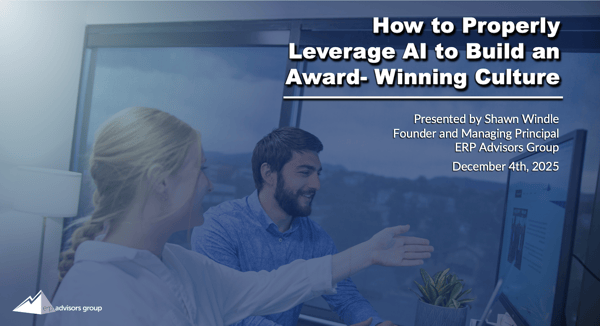
Introduction: This is the ERP Advisor. Today's episode, How to Properly Leverage AI to Build an Award-Winning Culture.
Rebekah McCabe: Hello, everyone. Thank you so much for joining us for today's CPE webinar, how to properly leverage AI to build an award-winning culture. In this CPE presentation, our presenter will apply over 3 decades of practical technology experience to tackle one of the most pressing topics facing businesses today. How can we build an award-winning culture via AI? During this seminar, we will cover the following learning objectives. How the AI evolution is impacting workplace culture, how businesses should respond to new AI tools and advancements, developing an approach that enhances your culture and helps you attract and retain talent, tips for fostering an AI positive and empowered culture, and how to address common objections and win over AI naysayers. Today's presentation is valid for one CPE credit. In order to receive CPE credit, each attendee is required to attend the full 50-minute presentation, as well as engage and answer all of the polling questions asked throughout the presentation. If you are needing CPE credit for today's presentation, please leave your name in the chat of this Zoom or send an e-mail to Elizabeth at elizabeth.jones at ERPadvisorsgroup.com for record and you will be issued a certificate for CPE. At the end of today's presentation, there will be a short question and answer period. And if you have a question for our presenter, please add it to the chat section of the Zoom and we will be sure to get that over to him. Shawn Windle is our presenter for today. Shawn is the founder and managing principal of ERP Advisors Group based in Denver, Colorado. Shawn has worked in the enterprise software industry for almost 30 years. He started his career at Accenture and Arthur Andersen Business Consulting and moved into the software industry with Oracle as a technology product manager. There are only a few people in the world with the practical software experience that Shawn has gained with helping hundreds of clients across many industries with selecting and implementing a wide variety of enterprise solutions. His podcast, The ERP Advisor, has hundreds of episodes with 10s of thousands of downloads and is featured on prominent podcast platforms such as Apple and Spotify. Shawn, if you are ready, I will pass it over to you to begin our presentation for today.
Shawn Windle: Great. Thanks, Rebekah, as always, for introducing me. And to be honest with you, Sometimes I'm like, when I see those Star Wars toys behind you, the Legos, I just want to go play with those and not think about really hard topics. But it's time to get to work. So with that intro, again, appreciate it. And really appreciate everybody joining here, especially coming into the holidays. It is a reporting year, I understand. So I'm glad to have you all here. And please, any logistics, I think somebody just sent a note on the chat to get CPE credit. Just let us know for sure. We'll track that and do everything we can to get to you, make sure that you have what you need. So just one last thing I'll say here before I jump into the content. The framework that I'm talking from today, or I should say kind of the backdrop that I'm talking from, is This is all we do as a firm, is advise organizations, non-profits, for-profits, public, private, government, quasi-government. We work with a ton of organizations, people that are basically dealing with enterprise software issues. Frankly, they have the guts to help their organizations to get through some of the toughest challenges that they're going to see with technology. And so usually those are the people that are joining us for these calls, too. So I really admire you all and please take the points that I'm going to talk to you today. There's going to be some great nuggets for sure, but I really think they're going to help you. And that's that's the spirit in which we're talking to you from here. So with that, let's jump into it. Okay, so here's the thing. This topic about AI and culture, I'm super excited about it. I think my team is, too. They're all here with me. Hey, guys. Wish I could turn the camera to show them. And they've been more than gracious with like, okay, Shawn, like, we see it, but like, why are we really getting into this? Like, you know, there's so many technical aspects of AI, artificial intelligence. that it's just a wild area. It literally is like the Wild West. I don't know if we have people from international joining us here today. Sometimes we do. It's really the settling of the Western United States was wild. There was a lot of things that happened. And I'm telling you, that is like how AI is. Hopefully there's less whatever stuff was back then, but we won't get into all those kinds of history points. We're in Colorado, so it means a lot to me. Growing up doing Colorado history, you guys probably did Colorado history stuff. It's wild that, of course, we have the Eastern guy over here who is from Boston. But anyway, that's okay. But the point of what I'm trying to say is that this is a very wide area of artificial intelligence. And it's kind of funny, too, because I think as we're engaging more with different people talking about this topic, all the way from my partner, right, who in the business, but who's also my wife, who's like, if I hear anything else about AI, I've got to go crazy. Because she's very specific. She's a very, like, she basically runs the administration for our practice. And, you know, she's pretty good at it. At least Consulting Magazine thought so. She just won a big award, which was super cool. She was an honoree for, was an operations and strategy for, women's leaders with Consulting Magazine. I think it was. Yeah, operations. And she was amazing, right? And she's like, you know, like, what does this really mean for our business? Like, what does it really mean for our clients, right? And that's what I really want to talk to you from today, which is like, what are the real impacts? But instead of just talking about like technology, which we're doing a lot, and we're talking to all of our vendors, including the AI-based ERP companies that are emerging and have $100 million all of a sudden to the incumbent ERP vendors, we're getting into a lot of that. But for this conversation, we are purposely talking about culture. And I should say one last thing, too, that from my perspective, I always look at like, who's going to listen to me talk about stuff and what right do I have? What have I done to demonstrate my capability in an area? And I will tell you that One of the most proud things I am about our organization is we've won the Best Place to Work award in Denver for multiple years now. And we keep getting up into bigger organizations. We keep placing, which is amazing. That means everything to me. So I do know about culture, not just from working with some of the top organizations in the world. The last firm I was with before I came here is in the best place to work nationally. And then we've been able to build it here at ERP Advisors Group. So this whole conversation is around how do you take this technical aspects of AI and apply it to like culture? So why are we really talking about this? And I will jump into the content here with that backdrop. There is so much fear around job security with AI that when there's that much concern about anything, it's hard for people to see what benefits could be. And I don't think that it's unfounded. I think it's really true. Even as we're looking at our AI strategy internally and how we can leverage real tools that are going to make a difference, I can see that it's going to impact people at our firm in a way that's going to make them more productive, a lot more productive. And I think we're really excited about that as a firm. Now, we tend, I hope you guys would agree, you better nod, yes, that we really want to take care of our people and do the right things for everybody. And by having AI tools that can make a difference, you can get past some of these concerns. I think, Rebekah especially, you did a phenomenal job putting this deck together in terms of the actual statistics and research that's in here. And Elizabeth, yes, thank you both for doing this. I think Elizabeth's listening, too. Thank you, Elizabeth. But 52% of surveyed adults are worried about the future impact of AI in the workplace. So if you have that much fear and that much concern, it's very hard to see what the upside could be. So there's truth in that, right? And then if you've got one in three people basically thinking that their future progression could be blunted by AI, that's a big deal. Like, I can't think in my several decades here of my work sort of career or path, You know, we've had some major changes with with cloud. We've had the Ubering of all these industries with just even e-commerce and things like that. I don't think you're going to see that kind of an impact from anything that's happened, at least in the last maybe 30, 40, 50 years where people are that concerned. And the next point here is is sort of an underlying point here that there really isn't any kind of guidance or policies for using AI at work. It's so new that organizations don't know what to do. And frankly, you know, some organizations like us have just said, you know, our data is so valuable and especially our client data, and we're having pretty intimate conversations with our clients, like we can't let that data go anywhere, even if it's just a status meeting with an AI tool taking notes, like where does that information go, right? So we're finding very trusted providers doing some pilots with them now, but the policies are just not there yet because we haven't been through enough of the consequences of our decisions on AI. So that's the second thing here. And now all this AI stuff comes to us here on this third major point around the cybersecurity threats that we've been talking about with Nobe4, one of our trusted partners in that area. We don't take a dime from them. They don't take a dime from us. We love those guys 'cause they're out making a huge difference for organizations around cybersecurity and teaching and educating people about what to do and what not to do. But when we talk to them every year, the stories get worse and worse and worse of what happens. So even if you look at sort of a survey done by a cybersecurity organization called SoSafe, you know, over three quarters of businesses are targeted by AI-fueled cyber attacks. Like, wow, so we already knew cybersecurity was a risk, and now AI's being used for that. And the last couple kind of negative points here, right? But potential of retrieval of inaccurate information, right? So when we were just talking to somebody literally yesterday about an AI tool that they were using over their financial systems, and the tool would go and pull information and bring it back, and it was wrong. It was like, what was my revenue for this client for this period of time? Go out, here comes a number. The way that the AI UI user experience was wired to the UI kind of code that's built that then goes through an integration, that then goes through an API at the ERP level. And then within the within the ERP, the calls that were made to the database and brought back all that technical stuff, they missed information, you know, and you can see how it'd be easy to leave out things like credits. So yeah, here's the top line number, but we had lots of credits that went back to customers. I mean, that's just a simple example. So if KPMG is doing surveys and saying that half the people admit there's issues, that's tricky. And then the last point on here is inappropriate targeting spend on unimpactful AI tools that really don't impact ROI, right? These are like experiments, basically, that's going on. So the reality of the adoption of where real ROI is coming from, it's just not there yet. Now, that's not to say that it's always going to be this way and that we shouldn't continue to talk about the pros, which we will in a second here. But normally when we start off a deck, we're like, oh, hey, everything's great. Here's the way to be positive and da, da, da. But this sort of lays, again, sort of a framework that we're all operating from that like, you better be paying attention here because the risks are high. And it's not just technology and to the reports and analytics that you're getting, it's actually to your people because the impact of even you or your CFO, your controllers or senior accountants or even junior accountants, even people that are the junior, junior accountants, they're using these tools to come back with information and then it's wrong and somebody smacks them, hey, what are you doing? That's the wrong data. Like, hey, I'm just using the tools here. So lots of risks for sure. But the reality is, as we go to the next slide, we all kind of know, though, that there's pros. And that's why we're going through, I think, the uncertainties that we are. Like, it's worth it to work through the cons that we just talked about for some of these pros that I'll talk about over the next two or three slides. So we all sort of know that the empowerment, not just efficiency, and more time for value-added tasks, but the actual empowerment that a person gets from working through images, thinking about your job and what you guys do. How do we clean up images and make them crisper or whatever? And if we have tools that can do that automagically, AI-based tools, then we can take those images, we can create content that's more aesthetic and we can get it out. That's a marketing viewpoint, but much less around accounting and finance, those same points are there. It will require people to learn the AI tools and understand the risks to be more effective with it. And so just like everything else around technology, training becomes the key for us to be able to reap the benefits. And again, some of the sources are cited here. We can get this deck to you too, send us a note on the chat, we'll send it over. But there's unequivocal truth that employee-- there's my word, unequivocal. Rebekah's got me on that. That's an inside story there. But employee empowerment is really like the ultimate here. And now, does that mean that we build robots that can think like us? Some people think that, and they're doing it. And I was watching the video yesterday of the hand and the running and stuff. But that's another topic for another time. But when you think about us as employees, us as knowledge workers working with knowledge, it will change what we're doing. And that the value add task is very real for sure. And it's not just about us individually, it's also about processes. So we've talked about business process regeneering since the '80s, the late '80s. streamlining and process automation, robotic process automation, all this process stuff for my entire career. And we've tried to get systems in place to do this optimization that, you know, we've done the best we could, right? But now that we're looking at a whole nother level of computing at the AI level, we can do things like looking at historical data for predictive patterns. Like we're going to talk about this a lot, how more vital your data is in the AI era. But we can do real continuous, real-time monitoring, not just of like the security industry whose job it is to watch over our most trusted assets, like visually, right, graphically, but even looking at things like receipt times in the warehouse and movements and like what's really happening real time around the world with our larger wholesale distributors and where their inventory is. I mean, even using some natural language processing, NLP, to start working through real workflow issues that are out in the workplace and then getting things like predictive machine learning. They're definitely, they're buzzwords. I don't think of them as buzzwords as much as I think about them as misunderstood technologies. And AI becomes the thing that all of these tools that have been being worked on for the last 10 years or more, really even workflow, I mean, we were building out workflows at JD Edwards in 2000, 2001 that could interoperate across multiple applications, right? There's the semantic web that Tim Berners-Lee was putting together around that time, which was how do all these services work with each other? There's been all these tools forever. We're really there, like we've actually kind of are being able to achieve some of those things. So there's totally pros there. There's a couple more I'll talk about here, too, if we go to the next slide. I love this point from Gallup, right? 45% of employees say their productivity and efficiency and their role has improved because of AI. Now, this is for organizations that are using it. If I think about my job and there are repetitive, historical, mundane things that I do that I just have to do because they have to get done, and if we're building out in an agentic environment where we have agents, we start naming them, whatever that's going to be. And these things can really start doing the automation that we're starting to see today. We just saw a demo of a tool earlier this week that even helps organizations that are in the implementation industry, the software implementation industry, to be able to create scoping documents and requirements documents with a push of a button. Now, are they completed? Of course not. But the repetitive historical manual tasks get automated, and then the individual whose job it is to bring the value on top of that can do their part. But see, they're not just going to just work less. They can actually take what's been automated, and then they have the time finally to do much more value add. That's the benefit there. Ongoing completion of vital tasks, very similar. And when we think about financial close, trend monitoring around business intelligence and KPIs and then inventory tracking, et cetera, et cetera, AR, outstanding dunning processes, AP, that you just think about the ongoing completion tasks that need to be completed on a daily basis. We are going to be driving up productivity globally with these tools, right? Like significantly. And it all leads, I think, to this last point on this slide, which is better decision making. So if we do have a data-driven technology that is able to provide us information in a way that is more useful and consumable, that we will make better decisions. And I know this because I've been selling that as a benefit for ERP with our clients, not even our prospects, but once we're a client, with almost every single of the 600 projects plus that we've done in the last 15 years, every single client that I've worked with has always said, we're going through this ERP transformation or human capital management or patient care reporting or whatever, because we've got to have better information about organization so that we can get ourselves in a position where we're adding more value to our customers and to our employees, and our employees can do that. So this is a lot of sort of high-level stuff for sure. We're going to get into some details, but the pros are definitely there for sure. So let's go to our first question to make sure that everybody is still awake. Here's the thing. If you have any questions, I probably said something that you didn't understand. I'm totally fine with you all. Please coming back to me with anything in the chat, and our team can monitor that. So here's the first question for you. AI is benefiting the workplace by empowering employees to be more efficient, informing decisions, improving processes with data and bottleneck detection, or D, all the above. And remember, people, we don't sell GPUs. We don't sell data center storage or capacity or performance. You know, we're not selling you apps around BI or an AI, AI, EIO. Like we don't do that. You know, we're really in the business of helping our clients basically achieve their goals through technology. So I'm not trying to paint a picture of just, oh, it's going to be, a friend of mine kept using this phrase, yeah, rainbows and unicorns recently. And long story, but that's not what this is. This is happening and it will continue to happen. So let's see. I think we got some good responses in, so the answer is all the above. Perfect. Let's go on here. So thank you for your points there. Nope. OK. Ah, OK. Great. OK, so we've talked about the cons. They're real. We've talked about the pros. They're real. That's probably why you came to this webinar, is that you know implicitly or explicitly with the work that you're doing, that this is the truth. So what do you do about it? And this is sort of from the viewpoint, again, of having hundreds or thousands of people that I've worked with and that my firm has worked with and my people, even more importantly, have worked with, that we've helped through technology dilemmas, problems, situations, and like it's sort of like real is what I'm trying to get to. You really, yeah, this optimistic skepticism is, I think you used to be cautiously optimistic was the phrase, but optimistic skepticism is exactly the right viewpoint. And I'm going to give you a very specific example of this that I don't want you to forget. So it's very easy, even having to talk to my team about this, to just sort of like, you know, you can tell how old I am sometime with my analogies, but drink the Kool-Aid of AI. Does you guys even know what Kool-Aid is? Oh, good. Okay. They're nodding at me like, not really, but I do. No, just kidding. Everybody knows what Kool-Aid is. Do you remember the commercials with the Kool-Aid man? Okay, there we go. Thank you, guys. Again, they're too nice to me. But but, you know, the the optimism of AI is is like it's probably I would say more I'd even almost say five times more than the telco bubble or, you know, the upward finance things going on in the 2005 timeframe or ML machine learning or RPA, you know, all that kind of stuff. Like it's five times more on AI. But I will tell you, This time is very, this tech trend is very, very, very well funded. Put your money where your mouth is. Put your mouth where your money is. And that is what's happening. And it's not just one company or five companies or one country. This is globally. And we see even countries making huge investments around technology infrastructure that I'd tell you, they should have done a while ago, to be totally honest with you. The opportunity was there. But for various reasons, now it's happening. So the optimism, it's very easy to be overly optimistic about this. And it's also very easy to be very skeptical about it. Just going through those cons are there too. But you kind of have to be both. And we're even saying that when somebody comes to you and says, hey, I can build you, I was going to say an app for that, right? That's what we used to say. Now it's an agent for that. There's truth to that. Those agents can be built. But in talking with some organizations recently, sort of early adopters, if you will, they had worked with one of the model companies. I'm not going to say which one. And with some updates that they had done, they broke integrations, they broke key components of the models that this organization had built with their upgrades. And you're not going to go to this multi-billion dollar organization and say, hey, you broke my model, so I want my money back, or I want you to fix this, or, or, or, right? It's sort of like, it's risky. You're not taking your life in your own hands when you're building these things, right? But you kind of are. So, working with more prevalent providers there is the solution. I'll talk about that more in a little bit. But you need to have that amount of skepticism, like, okay, yeah, if somebody comes to you and says, I can build out some agents for exactly that business model, it's going to cost whatever they say, I would multiply it times 3 in your own mind and not tell them. And you have to look at that and say, is it really worth it or not? You sort of have to have the idea of the business benefit, the optimistic side, wow, this could really improve our performance, our throughput, our customer relations, interactions, da, da, da, da, da, by 10, let's just say the number of 10, and it's going to cost me, they're saying it's going to cost me a factor of 1. I know it's really going to be 3, and even if it all goes away in six months, I still have time to get my ROI from that. Let's go, right? I didn't even talk about whether it was Anthropic or Llama or whatever, Grok. I didn't talk about if it's customer service or financial close, you know, in zero days, right? You're hearing a lot of that from the AI ERP vendors. Just use the model that I just said there. And so when we talk about optimistic skepticism, that's exactly what we mean from a formulaic perspective, if that made any sense. Did that make any sense? Okay, good. They're nodding. Good. All right, don't get complacent or you'll risk falling behind. It's so easy to just sit back and do nothing and see what happens, et cetera, et cetera, et cetera, especially with the risk. You really can't do it. So I was talking to a friend, my mentee, actually, from the last organization I was with. He started his own business. He's doing great. And he's got a guy who's building out some AI stuff for him. And we had this exact same conversation with him. And I can tell you that last year, I would have said to him, Stop. Don't do it. Like, no, we're not there. But this year I said, I love what you're doing. Keep experimenting, but look at it as an experiment for right now. Because the more you learn and the more you understand about this, that as solutions solidify, you'll be in a position where you can leverage it. And then definitely keep up with current news and innovations. I think even in 2026, you know, we have the ERP Minute. We might even call it the ERP AI Minute. I think there's so much. I'm looking at Rebekah, who's responsible for this. I'm assigning her this, like literally live on a CPE, so she can't say no, which she will later if she doesn't want to do it, which she should. But I'm serious. I think we should start covering those five or six key organizations beyond just the ERP vendors that are coming up with new models. And Rebekah's already doing this work. I think we just need to share it more through our ERP minute, ERP AI minute. Something like that. ERP AIM. ERP AIM. That's right. ERP AIM. There we go. I love that. But there's other places. I ended up on some rando e-mail that I get every day, it seems like, on AI stuff. And I'm like, unsubscribe. But I'm like, oh, wait a minute. This is kind of interesting. Oh, this is really interesting. And so the news, the outlets are out there for sure, and it's a good time to stay on them. Okay. I think we have a couple more points here, too, on this next slide. So evaluate vendor strategies. And when we say strategies, we're not just talking about the tool that they're using or the cost of the tool. This is like, what's their go-to-market strategy? Meaning, are they just a tool provider or do they have resources that are implementing these tools that you can go to that are kind of like a liaison between you and the tool provider? We just saw one literally on our team yesterday, from somebody who referred us into. I mean, I think it's cool, but a lot of these tools seem to be named like women's names. I don't get that. I don't know, but I like it. That's cool. So we just saw one that had a lady's name, fine. And Quentin on our team, who's our early tech guy, was checking it out. And he was like, this sort of sits on top of these LLMs. The multiple LLMs does internet stuff, da, da, da, da, da. And so there's some cool tools that are out there, but you've got to understand, okay, well, how do they want to go to market? How are they working with partners? What kind of R&D are they putting into their tools? How are they selling the tools? These are really basic questions. You don't have to even write down what I say, said, you just have to look at it from a viewpoint of overall strategy of what the vendor is doing, not just, oh my gosh, they can meet this need today. Just ask the questions that you would if you were betting your job on using one of these things, because in a way, you probably are. And that's no different in advice that we've given you for all the other software that we've advised people over the years. And that gets to the second point here is you definitely ask the questions. This is one area where it's so easy to get so lost so quickly. And you'll know you're lost, by the way, when you're talking to a vendor, because that's when you start going into your e-mail while they're talking or you start daydreaming or you start like thinking about, you know, what you had for breakfast that morning. When you're in these conversations, maybe even with me right now, I would ask if we're daydreaming or whatever, it's okay to stop and just say, You said something I don't understand. It's called a misunderstood word. That is going to happen in this space of artificial intelligence. It's unequivocally. If your boss is doing it to you, that's a different story. You definitely have to pretend like you're there. I think my team does a good job with that, but then they Google and they get on ChatGPT and find out what we're talking about. But they're also telling me, Shawn, not right. This is what it means. But it's true that you need to ask questions so that your own understanding can go up. And then ultimately, now you can get to the point of like calculating like, okay, here's what the return on investment really is, including padding, right? I mean, we've seen this with custom systems for, I don't know, every single project I've ever done, literally. And like since 1996, Ryan, who's on our team, and I started it, I think it was July 10, 1996 at Accenture. Every custom development project, which a lot of these AI projects are, goes over budget. Every single one of them. So if you know that and you can calculate with that, you can get your budget set with the vendor. You definitely need to define what the scope is, what problems are you trying to solve, et cetera, et cetera, et cetera. And then the unknowns about how the tools fit in, yada, yada, sort of kicks in. But hopefully you put a little bit more money aside so that you don't, I'm just going to say, it looks like an idiot going back to your boss saying, oh, we're halfway done and we used 100% of the budget. Don't do that. Calculating your ROI decision enough of a cushion there that if you do need to use it, great, and that you're still making the ROI that you need to do that. So I'm kind of harping a little bit here. Let's put some more questions out here. So which of the following is not a way to respond to AI tools and advancements? So evaluate vendor strategies. Sounds good. B, let only the experts do the research. Don't, please. And then make calculated decisions for ROI. What do you think on this one? We'll see what your responses are. I think that we're-- I think as a society, we're getting to a point with-- and it's really phones. I mean, it's the phones that changed everything that we can compute so quickly. That, you know, AI is just like this, like it's the next evolution of all the infrastructure that we've been putting in place as a civilization. I mean, since, you know, anyway, I could go back to the railroad industry, transportation in 1800s, but it's just a natural evolution for sure. But anyway, we're not here for a history lesson. Okay. Good. Good. We got some answers back. Definitely. You definitely, definitely, definitely want to do things on your own as well as talk to people like us, talk to other experts that are out there. Independent objective people are the best, but sometimes you just got to go to the expert on anthropic or you've got to go to some people over at Google Gemini and find out what's really going on there too. Good. Okay. It's been a little bit technical what I've been talking about here, but I really do want to bring it back to, I want to bring it back to you. I want to bring it back to your people. And just as important is also the future people in your workplace and who's going to help you to grow and expand. Because it doesn't matter how much AI you have, how much ML, RPA, ERP, blah, blah, blah. Organizations are built and run and operated by people. They will, in my opinion, it's always been that way. It will always be that way. Now, can those people do more with technology? Absolutely. But I really don't think that fundamentally changes, even if, you know, we can teach optimist robots how to answer phones and do whatever. I know that's going to happen, of course it is, but it's still, there's so many people that want to create and do wonderful things. I really hope that from this presentation, you can take that viewpoint for yourself. And even after this presentation, I do want you to do something. I'm doing this for free for you guys. I mean, it helps us to get our name out, don't get me wrong. But something you can do for me, which isn't really for me, it's more for you. But as soon as this is done, like and you close your computer, you shut it down, or maybe you go to lunch or whatever, like I just want you to look around your office. And maybe you're on Zoom and you're working from home today or whatever, like the next call you're on, you see those little with all the people or even open up your directory or open up your e-mail, look at your contacts. I don't care what it is, but just realize all these people are there working with you trying to accomplish the same thing. And it's freaking beautiful. Like it's amazing that we're doing this. And so people coming together and accomplishing goals that are bigger than themselves, right? That's when we're talking about enhancing the workplace culture with AI, that's really what we see is the goal here. And again, it's not just for the people that you're working with today, but, and it's a weird time where unemployment is sort of high, but it's sort of low. I saw this point called the K-curve the other day of sort of, kind of the economic classes are going up and some are going down. And it's such a strange environment, economics that we're living in. But I mean, we have six or seven job openings ourselves, all of our clients are looking to hire great people. So I see this, I think my team agrees with this, like your future people, they're going to be looking at AI strategy as a reason for why they're going to organizations. They know their lives will be improved day-to-day. Their jobs will be better because of AI tools. I'm thinking about one gal, Hannah, who joined us recently. She's amazing. That's how you're getting old when you used to... Did you guys know that I worked with her dad at the last company? Oh my God. Yeah, Lawrence, great guy. Love him. And now she's part of our family, which is super cool. But I know when she was talking to us, she's savvy. She is smart. And I know she was looking and she had questions about, well, so what tools do you guys use? 'Cause like... I don't wanna be doing a bunch of manual stuff if I don't have to. Now she's like cranking through pain points and observations and going through all this stuff. And I know she's thinking with like, okay, EAG, can we get some tools in here to make my job better, right? I think you guys are thinking with that. Here's I'm looking at the marketing team. Especially people that are kind of like, I don't know, they're more interested in having more maybe full lives. I think we all are, but I just think there's more of like a, a mandate that we see from our, what generation? X, Z, ABC, Z. So we have Z and we have millennials and Z's are saying like, you know, especially as I look at Will, who lives the life I wish I had, but that's another story for another time. I always talk about Will on these calls, but you know, who just got his, it's a commercial pilot's license. It's amazing, right? I think about Rebekah, who recently, if I can say this, okay, recently got engaged, and Charlie and his girlfriend, and you guys are making, just joining us in the organization. People are really wanting to make their lives better, and they should. They should be able to do that. And that's the benefit that we see for your potential employees with AI, right? You don't want to spend hours fixing spreadsheets anymore. And they want stability with companies that are innovating. They know that the more AI we're using, actually the innovation occurs, the more stability comes out there. Like, that's just the truth. And then if we go to the next slide, the thing about it is that there are definitely solutions currently available that can do these things that we're talking about, specifically in the office of the CFO, the accounting and finance business processes. They really do improve your employees' lives. Now, again, optimistically, what was it? Yeah, optimistic skepticism here, right? Movement toward a zero-day close using financial AI agents. We were just talking about what that really means, right? And if some of your biggest vendors don't get you a bill until the fifth of the month and you do an accrual, it's easy, right? There's very specific methods that you all probably know better than I do, I'm a systems person. But there's things you can do to reduce your close, but even having more capability, software, agents that can look at improving your bank reconciliation. How can we take those transactions that are super close that don't quite match that we have the ability to do today and have more intelligence built into the apps so that we can have more match happening quickly and easier? I mean, those are real things that can happen, and people are going to start expecting that, right? Invoice automation using things like OCR and automated approval workflows, right? Discrepancy detection, predictive invoicing, and more. We've set the stage with those tools already. Those tools exist, but I don't know. Most people I talk to about OCR, there's some problems with it, and the match doesn't necessarily do that good. That's getting better and better. Planning and budgeting, there's tools. There's a specific AI-based financial budgeting tool we've looked at that's pretty strong. We're seeing some of the incumbent players now, like Adaptive. They're really getting into AI and doing things where you can have better prediction. And then certainly reporting with dashboards. And we have several organizations we're working with now that are taking large language models, their LLMs, putting in their own data, and pulling back things that are really like more useful than they've ever had before. So these things are definitely happening. I mean, we're helping organizations to work through this on a day in and day out basis. Frankly, we're learning too. I don't think anybody can tell you on any of these, like, okay, real, it's the way to go for the first bullet. We're trying to learn more about them and Campfire and what for real is NetSuite next and working very closely with Acumatica and Microsoft. We're doing a call with some Microsoft people coming up because it's all right there in the Microsoft ERP environment and ecosystem and everybody knows the paperclip. Do you know the paperclip? Do you know what I'm talking about? gotcha. Okay. Yes. What is it? Yes, exactly. The Microsoft paperclip. Exactly. They've been doing AI since the paperclip that everybody shut off when it showed up. But we're out there working with all of our vendors, really trying to figure out what they really have. But these use cases are definitely very real and they're definitely happening for sure. Okay, we're getting close to the end here. So if you do have any questions, feel free to start putting them in and maybe my team can kind of track it. But let Let's do our next CPE question. We have one more after this. So true or false, there are real applicable ways I can effectively be applying AI to my business processes right now. And I'm going to change this blind while we're answering. This is a real background that it's not AI generated, by the way. It looks like it. AI is in, there's maybe a different definition of AI for nature, I don't know. So I'm excited to prove it. Yes, exactly. All right, we'll give you about 10 more seconds here to answer that. Good. I think the person answered false. I can't blame you. Yeah. That's the skepticism. That's right. All right, great. Thanks, everybody. OK, so just a couple more points here that I'll make. So again, hopefully from this discussion, you can focus on the positive impacts, right? But be transparent about the risks. Again, it's an area where you don't have to present yourself as if you know everything, because I think almost any person you talk to about it doesn't. Those listening to the NVIDIA podcast, the CEO from there with Joe Rogan of all people, it's kind of interesting. He knows a lot of what's going on for sure. Some of these people at the top, top do, but they don't know what each of the different frameworks are doing. And so they're trying to figure things out even at the very top. So for the rest of us, be transparent about the risk for sure. I do think if you switch the view from, oh my gosh, AI is this and that and that to like, hmm, how can we really improve our employee experience? I think the tools will start falling into place in terms of what you should be doing and what's obvious to take on and what's not. And it might sound a little cliche to say this, build a culture of innovation and progress, like we should do that anyway, regardless of technology. But the reality is, is that I think more people are becoming more aware of that, especially as we have the silver tsunami, right? If we talk about that. Distribution and manufacturing and engineering, we saw a stat on accountants that, was it 75% that are retiring in the next 15 years? It's crazy, right? I mean, we have a couple firms that help us out with our accounting, and there's a lot of innovative things that accountants are doing. So this culture of innovation and progress is going to help you to keep more people, I think, in your office of the CFO as they see that. And then even the education, like pull your people in to learn with you and ask people on your team to help with that research. Hopefully you don't. Give them a credit card and have them buy stuff, and they start experimenting with your data. Don't do that quite yet. We've had that happen. Some agent shows up on a call, and then we get some note that says da-da-da-da. And we're like, well, where'd that come from? And they're like, I have no idea. I just pushed a button. So not just that side of the security, but also of what is coming. Send them this DAC so people are familiar with and thinking about these things. And there is some other points here I'll make too coming up as we go to the next slide. There are going to be people that are going to say like, no, we're not gonna do anything, right? And again, we had a conversation just recently where somebody's like, okay, so why are we doing this if it's just gonna take all our jobs? That's not gonna happen. It's absolutely not gonna happen. And if it does, you can come back and find me. I will probably still be stuck in my job doing whatever I'm doing. But of course, there's going to be tasks and maybe even some positions that are taken over by AI. But man, it opens up so many more things than what we're doing today. And I think there are business leaders, philosophers, whatever you want to call them, that are trying to paint the picture of the future. It's kind of one of the benefits, frankly, of science fiction. is that when you read whatever you read, whatever you're into, you're sort of painting a picture of what could be for the future. I would look at what some of these industry pundits or these pioneers are setting out there for the future to say, okay, well, that's a future that could be, and how do I fit into that, and how do I want to, and how can I even affect that in my own organization? There are a lot of things that all of us do that are administrative and that are manual. Now, they're very important. But even in my own firm, I think about my people taking time to enter their time or consulting people. And there's already tools today that can basically scrape the calendar and put in time entries for that. As I'm looking at Natalie, who doesn't know I'm looking at her, she's in charge of our internal tools. And we've talked about like, how can we leverage those kinds of functionalities? 'Cause I don't want my people having to do that, they don't have to. But ultimately, technology has never, removed the need for human intervention across, I would say, our civilization. Has it changed it? Absolutely. Whether it's from fire all the way to, you know, robotic process automation, the human intervention is what gives life life on this planet. I don't know about others. We're not going to go into that. But on this one, anyway, from what I can see, you know, you need people and that's not going to go away. So that's some handlings there about that one. There's two more objections we're going to talk about here, and then we'll open it up for some questions. AI has proven zero ROI for companies currently investing in it. That actually isn't true. There is some returns, but like what we said here, it's still progressing, right? There's still progress that's being made with these solutions. And much like anything else, The early adopters are maybe a little bit more willing to take risk, and they're kind of taking on the responsibility, if you will, for the rest of us to kind of work through what some of those risks are so that over time, the solutions are more easy to deploy and are more certain for the rest of us who maybe aren't as risk tolerant. That there will be tools, there will be models, there will be solutions that are built in a way where we can leverage the technology. No different than how mid-size and even small business has leveraged ERP. When SAP didn't build SAP for my business, right? I mean, we're on the Inc. 5,000, you can see our revenues, 7 million, 8 million a year. You know, we use QuickBooks online and it works. It works really well for us, right? But for Intuit to take the time to build that out, Intuit had to know what even accounting systems and what ERP and all this other stuff sort of looked like, which was defined at this macro level that then was brought down to organizations like ours that we could do that. That's going to happen with the AI models and data sets, and it already is. So then the last thing we would sort of dispel here is that there are the major cybersecurity threats. There are definitely risks, but when there is education that's put in place and there's proper usage, it is safe. And frankly, even as we kind of look at our internal use of this, we really are educating ourselves on where does all the data go? Where does it reside? What happens if that organization goes out of business? Because there is a lot of change. Do we lose all our data when one day the door is locked? That happened to me on my, let's see, my first job was that, second job. Third job, I was with the company that got bought by, this was a startup in 2000, where they actually basically said to me, like, you know, Shawn, we're not thinking it's a good fit with you anymore. And I'm like, am I fired? What's going on here? And they gave me some time to go find something else. And I did. I had mentioned something about investing $10 million a year in a software solution that I didn't think was viable. And then the next day I came in and they're like, You probably need to find something else. And I was like, okay, that's personal story there. And then about a month after that happened, all my friends showed up to the place to go to work, like their office, and tried to open the door and it was locked and they shut down. What happened to all the customers that were using those tools, right? So that's a risk, right? But when you look at AI generally, it is the proper controls are being built in. And so again, pick solutions and they're not going to go out of business. Hopefully you never forget that story. But also the vendors who are heavily investing in AI security. And this is why very often we like the solutions that companies that are already dealing with these problems are that they're kind of at a gradient of like, oh, we get hit by a billion bots a day trying to break down our firewalls and none come through, right? Like those kinds of organizations know cybersecurity. So then to have AI inside of that makes a lot of sense. Okay, so last question here. Thank you for making it this far in. A common objection to AI is AI is going to take all our jobs. AI has proven zero ROI for companies currently investing in it. AI presents a major security threat to businesses. Oh, it's fun times. I would say that, you know, I think we're hearing less of these kinds of objections as you all are answering here. We'll leave it open for another 30 seconds or so. But there is truth in these also. There's always a kernel of truth in all this stuff, you know? So if you can address that kernel and then work through it, you're golden, and it's worth it. Good. I think we have our final answer. Here is all the above. Good. All right. I've talked a lot about this. We do have a couple other events coming up we'd love for you to join us for. I have to put in a plug for those for next week. The 10th, we're going to go through part one of our ERP trends and predictions. We're going to do a second when there's so much stuff that the team's put together. When I say the team and it's content, that means Rebekah. For us to go through, which is going to be fantastic. We're going to talk about AI investments and strategies and everything else. So join us next week. But hopefully you're leaving this in the CPE with a little bit different viewpoint, with a little bit more understanding of the importance of AI impacting culture and the opportunity that you have, especially as the workforce and the war off for talent is not ever going away, that it's something that you can use and look at just differently from, hey, how can I reduce my DSO, day sales outstanding? To like, how can I actually get great people who want to be a part of the mission and the purpose and goals that you have as an organization? So thank you.
Rebekah McCabe: Sure. I'm not on the mic so you'll have the link here. Okay. But how can businesses start assessing if their organization is ready for AI?
Shawn Windle: Oh, great question. So how can businesses start assessing if their organization is ready for AI? That is a phenomenal question. I'm going to probably answer it a little bit differently than maybe you were thinking I would. It's really about risk tolerance in general. So when you look across the organization and you look at the investments that the organization's willing to make for, I don't know, changing out a vendor that does something really simple or getting new space or you know, basic business decisions that every organization has to make, how does our organization respond to that? And watch it, like observe it for yourself, observe the obvious. And you'll see what the tolerance is from the people that have basically the money and are going to be funding projects. And if you see that there's a medium level, then or if it's you who's making those decisions, you need to look at it for yourself. And if there's a medium level of tolerance of risk for any sort of business initiative, it's time to do something. Now, if there's like a high risk, you probably already are doing something. If it's a low risk, I would say not yet. And the reason why I say that is because there is a high likelihood that whatever you do and invest in AI, you're going to change in the short term. And the people who will look at that change is like, oh my gosh, we wasted this money and we had to throw this tool away and we went through all that pain and anguish and da-da-da-da. Yeah, but there's another set of people, maybe the tone is a little higher that says, wow, we learned so much through that activity that now that we know which tool to go with, we know our requirements better. We know how to structure our data better. We know the business processes that make sense to apply. AI to that we didn't before. We see the impact to our culture now. We see that our employees are like jazzed about working with us because we're doing some things that we hadn't done before, right? Those are those back maybe intrinsic values of a of any kind of a technology investment are so high that you will only get kind of a less quantitative ROI, maybe more qualitative with whatever tools that you choose. And you might even make kind of an internal PR thing about it and communicate, hey, here's what we're doing on AI. Here's the projects that we're working on, and let us know if you want to be a part of it or whatever. Because good people, yeah, they're going to make time in their busy schedules to be part of stuff that they want to do. So that's honestly what I would say. But again, my job is to make sure that you have a job after you make these technology changes. Don't do this if there's low risk tolerance for your organization. I don't think that there's a high likelihood that whatever you do a couple of years from now, it's going to seem like it's wrong because we just don't know which platforms are really going to exist. What is OpenAI really going to do? Is there going to be some, I shouldn't even say this, but some crazy lawsuit from somebody who used to say it was nonprofit and now it's for-profit and we only have a trillion dollars in capitalization and that's not enough. Pick something and do it if you have that tolerance. That's what I would say. Good.
Rebekah McCabe: Thank you, everyone. And thank you, Shawn, for sharing so much great information. I hope that you guys all, everyone attending this event got a lot out of it. If you have other questions and you didn't want to share them in the chat, please feel free to e-mail us. Shawn at erpadvisorsgroup.com, rebekah.mccabe at erpadvisorsgroup.com. We are here to answer any of that or provide some of our own resources. We have a lot of things already around AI and we're happy to help. And if you have, if you need a copy of today's deck from the presentation, please let us know. We're happy to send that to you. And also, if you e-mail Elizabeth, she can send that over to you as well. And if you need CPE credit for today's presentation and you didn't put your name in the chat, be sure to e-mail Elizabeth at elizabeth.jones@erpadvisorsgroup.com. You did have to answer the polling questions, so please be sure you did that and then e-mail over Elizabeth. And like Shawn said, be sure to join us for our next event, which is scheduled for Wednesday, December 10th at 12 PM Mountain Time, 2026 ERP Trends and Predictions Part One, and we will have Part Two. Shawn and I will get to analyze this year's hottest ERP trends and dive into some of our own predictions based off of the wild year we had that the vendors were investing in a lot of tools. Please go to our website, erpadvisorsgroup.com for more details and to register. ERP Advisors Group is one of the country's top independent software advisory firms. ERP Advisory Group advises mid to large-sized businesses on selecting and implementing business applications from enterprise resource planning, customer relationship management, human capital management, business intelligence, and other enterprise applications, which equate to millions of dollars in software deals each year across many industries. Thank you again for joining us today.


.png)
-1.png)