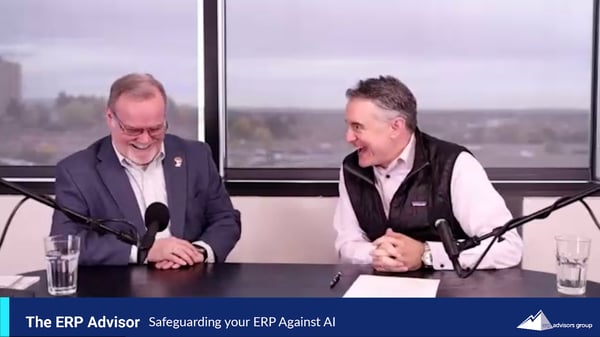
Your ERP is the heart of your business. It stores all your sensitive data in a single location, streamlining data access and improving decision-making. But that centralization also makes your data highly susceptible to cyberattacks and malicious actors. The rise of AI has not only made cybercriminals more resourceful but has also increased the threats from within. And as enterprise AI becomes more mainstream, internal controls will become more important than ever before. Join James McQuiggan, cybersecurity expert and Founder & Advisory CISO of Apparent Security, to learn how organizations can put safeguards in place to protect accuracy, prevent fraud, and build accountability across their organization, while still benefiting from the transformative power of AI.
How AI Has Changed Cyberattacks
Cyberattacks have posed a threat to businesses for years. From phishing emails and fraudulent phone calls to unauthorized access to sensitive information, enterprises are no strangers to combatting cybercriminals. Historically, however, these attacks took much more time and effort to orchestrate. Poorly written emails, suspicious links, and obvious inconsistencies often alerted employees that something was off.
But AI has changed that.
Cybercriminals can now leverage AI to research your company’s operations and employees, tailor phishing emails to specific individuals, and impersonate executives using AI-generated voices or live avatars during phone calls and virtual meetings. Hackers are also using AI to communicate in different languages, eliminating the grammatical errors that once made phishing emails easier to spot. These tools are not only making existing scams easier to execute and harder to recognize, but they’re also increasing the likelihood that employees unknowingly share sensitive information or provide unauthorized access to the enterprise.
At the same time, businesses adopting AI also face internal risks. Employees can expose confidential data through free AI tools, and autonomous AI agents introduce new vulnerabilities when given extensive access to business information. And the intentions are rarely malicious.
As AI adoption grows and cyberattacks become more sophisticated, it’s increasingly difficult for employees to distinguish legitimate communications from fraudulent requests. That’s why it’s essential for businesses to understand these risks, establish guardrails to protect their data, employees, and operations, and evolve their traditional security practices to address emerging threats.
The Risks of Using LLM Models
While AI can be used to target your business, you must also consider the risks associated with internal AI usage.
Large language models (LLMs), like Claude and ChatGPT, help employees automate tasks and improve efficiency. However, when employees use free AI accounts, they may unknowingly expose sensitive information that will then be used to train the AI model and become freely available online.
For example, an employee pastes confidential financial information into an AI chatbot to analyze a report or generate a summary. Depending on the tool’s settings, data-handling practices, and terms of use, that information may be retained or used to improve AI models. This exposure can have negative consequences for your organization’s proprietary data.
In today’s business environment, employees can become entry points for data exposure when they use AI without adequate safeguards. Even well-intentioned efforts to improve productivity can put an organization at risk.
But there are ways to mitigate these risks.
Businesses that adopt enterprise AI tools can benefit from enhanced security features, including administrative controls, access management, and organizational data protection. Depending on the vendor and configuration, these capabilities can help you control how employees use AI and how company information is handled.
However, deploying an enterprise application doesn’t automatically mean your sensitive data is protected. You must evaluate the tool’s security features, establish appropriate permissions, and create a review process to ensure that AI-generated information is accurate before it is used or distributed. You also cannot allow agents to act completely autonomously without human oversight.
Agentic AI Risks
Unlike tools that generate information in response to a prompt, AI agents can perform specific tasks, interact with applications, access data, and take actions toward a defined objective. While these capabilities improve efficiency, they can also carry unintended consequences.
Imagine your company creates an AI agent to oversee a database and optimize its performance. If the instructions aren’t clear, it might wipe the database clean instead of improving it. Although the agent may have interpreted its actions as a way to accomplish the assigned task, the outcome is disastrous. This is why it’s essential to be very specific about the instructions, permissions, and resources you provide to AI agents.
Using Governance to Mitigate Risks for AI Agents
When mitigating AI risks, you should treat AI agents as employees who require defined responsibilities, appropriate permissions, and supervision.
Developing clear guardrails within the system and around AI usage can help reduce the risk.
Limit access to information.
AI agents should only have access to the data and systems required to complete their assigned tasks. Avoid granting agents broad access to information or allowing them to take actions beyond their intended purpose. Limiting permissions reduces potential risks.
Define specific tasks and parameters.
Prompts should clearly outline the agent’s expectations, what actions are prohibited, and when it request assistance before moving forward. Clearly defined instructions reduce the chance of unintended consequences.
Maintain human oversight.
You should establish a human-in-the-loop process to review key outputs and approve work before execution. Just because AI can complete tasks autonomously does not mean it should operate without appropriate monitoring.
Human Risk Management
Technology alone can’t eliminate the risks associated with AI. Your employees also need to understand how their actions can affect your organization’s security and take responsibility for responsible AI usage.
This starts with workforce education around AI. A one-size-fits-all training approach may not work because employees have varying levels of AI experience and knowledge. Some may be hesitant to adopt the technology, while others are eager to use it without fully understanding its limitations. You need to meet employees where they are and tailor your communication and training to their roles, experiences, and familiarity with AI.
It’s just as important to communicate the benefits of AI. Rather than viewing AI as a threat to their jobs, employees should understand how it can help them work more efficiently. By automating repetitive tasks and reducing time spent on routine work, AI can free employees to focus on complex, time-consuming responsibilities that require human judgment.
When employees understand both the benefits and risks of AI, they are better equipped to use it responsibly and safeguard company information. Every individual has a role in responsible AI use, but you must empower your workforce with the knowledge and resources to do so.
Tips on Educating the Workforce on Safe AI Usage
Establishing AI policies is a good starting point, but writing them is easy; actually governing the technology is harder. For employees to develop safe AI habits, you need ongoing education, clear expectations, and opportunities to practice in a controlled environment.
Here are a few ways you can help your workforce use AI responsibly:
Make governance an ongoing process.
Because AI technology and cyber threats are constantly evolving, you need to regularly review approved AI tools, access permissions, and data protection practices to ensure your guardrails remain effective. You should also update policies as new risks emerge and communicate these changes to your employees.
Provide micro-learning opportunities
Rather than relying solely on security training, you can use short, recurring lessons to reinforce safe AI practices. Brief training sessions, real-world examples, and simulated phishing exercises can help employees recognize AI-generated scams, understand privacy risks, and learn to verify suspicious requests.
Create sandbox environments.
Employees also need opportunities to explore AI’s capabilities without risking sensitive information. Sandboxed environments let employees practice with AI while limiting their access to company systems and confidential information. You can also restrict permissions to ensure AI agents perform only authorized tasks.
By combining clear policies with ongoing education and hands-on learning, you can help employees use AI securely while reducing the risk of accidental data exposure and AI-enabled cyberattacks.
Conclusion
AI is improving efficiency and automating repetitive tasks, but it is also making cyberattacks more sophisticated and introducing new vulnerabilities. Organizations must take a proactive approach to risk management by adopting secure enterprise tools, setting appropriate boundaries, maintaining human oversight, and educating employees on safe AI use.
With the right safeguards in place, businesses can reduce their exposure to cyberattacks while still empowering employees with AI.
Ultimately, the goal isn’t to avoid AI but to understand its risks and implement the right guardrails. When you pair AI adoption with strong security practices and informed employees, you can harness AI’s benefits while protecting your data, systems, and operations. If you’re seeking guidance on ERP software or wondering which AI tools to adopt, schedule a free consultation with one of our experts today!