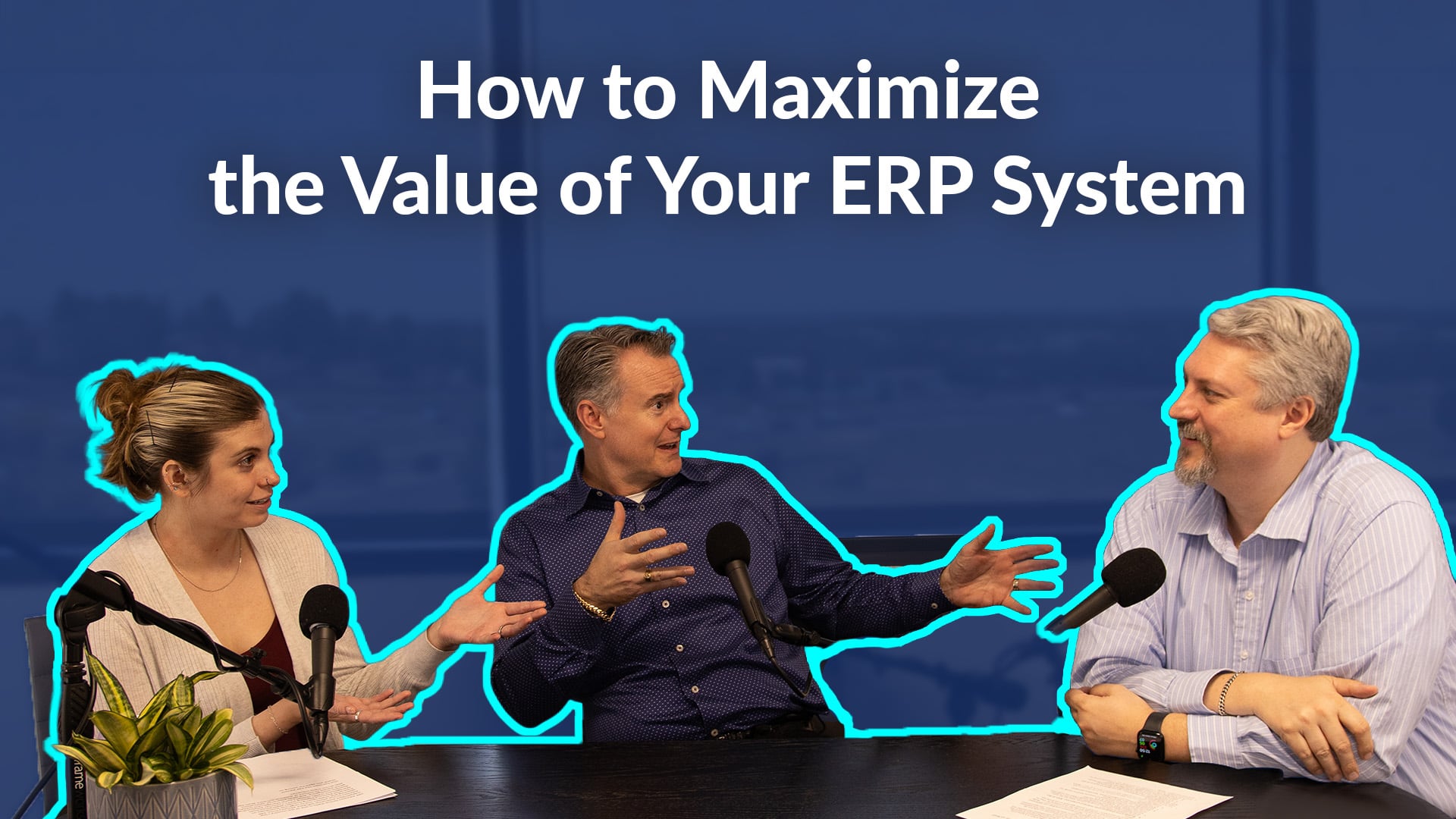
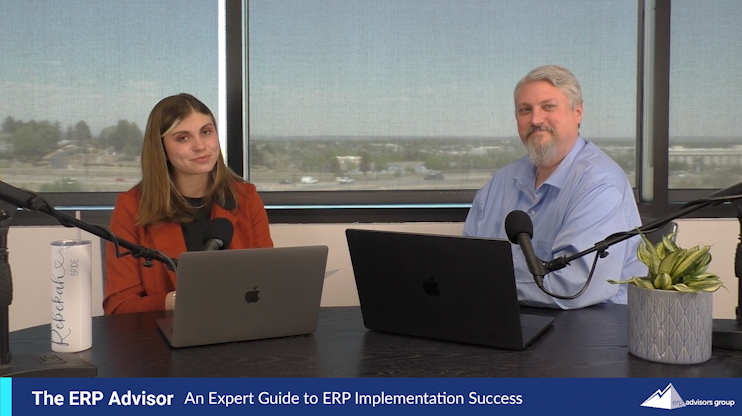
This year’s SuiteWorld conference went to Las Vegas, Nevada between October 16th and 18th. ERP Advisors Group’s Founder & Managing Principal, Shawn Windle, and Digital Marketing Manager, Rebekah McCabe, attended the conference to discover NetSuite’s new and exciting products and innovations. In this special bonus episode of The ERP Advisor, the two reflect on their experiences at SuiteWorld and share their thoughts on what’s on the horizon for ERP.


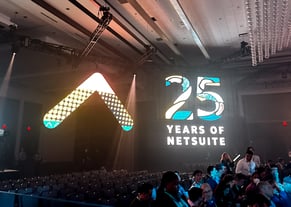

About ERP Advisors Group
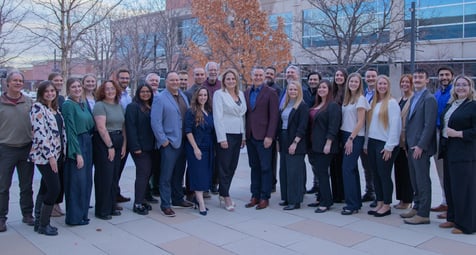
ERP Advisors Group only provides software advisory services. Our consultants only work on enterprise software selections and implementations. Therefore, they are experts in conducting software selections and know the pitfalls to avoid as they guide our clients to a successful go-live. You will find our consultants care deeply about your project and are vested as much as you are in making it a success. Ultimately, we will do just about anything to make sure you are a success!
ERP Advisors Group was founded by Shawn Windle in 2010. He helped develop the technology practice at the largest accounting firm in Denver from 2004 - 2010 by offering Needs Analysis and Selection projects. But Shawn saw that clients were struggling during their implementations, even though they selected the right software. The firm’s partners were too averse to the risk of losing tax and audit business from a risky implementation. Thus, ERP Advisors Group was born with the purpose to provide Client-Side Implementation Services.
We take responsibility for the decisions we help our clients make during the Selection phase by staying on for their implementation, ensuring they go live with their new software.
Download our free company brochure for more information about EAG.
Rebekah McCabe
Hello, everyone. Thank you so much for joining us today. My name is Rebekah. And again, you may recognize me from the ERP Minute every week. And I'm joined by Shawn, the founder and managing principal of ERP Advisors Group. Today, we are going to go over the Sweet World Conference that we just attended in Las Vegas last week and just discuss some of the major advancements that are coming from NetSuite and kind of give you guys our take and what we see for the company in the future. So thank you so much for joining me again, Shawn.
Shawn Windle
Sure. Yep. Glad that you are able to join, especially at the conferences. It makes a big difference. We can really cover a lot more with both of us there.
Rebekah McCabe
Yeah. And thank you so much to NetSuite for hosting us. We really appreciate it. gives us the opportunity as independent consultants to really learn more about the information and then bring it back to our teams and then also our clients who are evaluating different solutions. So just to get it started, I know the theme of the conference, according to Evan, on the first day of the keynote was suite up and the whole idea of doing more with less, automating processes, greater efficiency, growth in general. So can you kind of give us an overview of what that looked like from your perspective?
Shawn Windle
Yeah, I think Maybe a little bit of a trend too with some of the other vendors that we've seen this year. But I think NetSuite is really expanding beyond the apps for sure and going into the technology platform. Again, I think that's a trend for sure across all of the vendors. But NetSuite has this unique variable to it, which is this tiny company that owns them basically called Oracle, right? So you can probably talk to how you're even seeing, like for EPM, some of these solutions coming together, the enterprise performance management with NetSuite and the Oracle tools. But even on the infrastructure side, I think it's going to be a unique differentiator of NetSuite to leverage the capabilities that Oracle with lots and lots of development resources, NetSuite has a lot of development resources too, right? But I think there's just a big effort to leverage these technology platforms and sort of make the applications more robust, more capable, the integrations, the suite up, lots of analytics, lots of process automation, and of course, Any meeting today about software would not be complete unless we say AI. But there was a lot that was announced around that too. So we should definitely talk about that.
Rebekah McCabe
Yeah, we're definitely going to touch on AI. Like you said, we can't talk about ERP nowadays without talking about AI.
Shawn Windle
That's crazy.
Rebekah McCabe
And yeah, it's funny that you mentioned Oracle because that was a big thing that they mentioned throughout the entire conference. They said by the end of the year or January 1st, 2024, all customers will be running on OCI. So that's very interesting. And anybody, you can touch on this a little bit, but because I know some people might not understand just how valuable it is to have the OCI platform in the background, but it really is. And that was a huge thing to hear from NetSuite about how they're leveraging that technology.
Shawn Windle
Yeah, let's do talk about that because it's, there are different needs and there's different solutions. So what's right for one organization is not right for another. So let's say a company has a major investment in custom applications that they built that all run in Azure or that run at AWS. And then they have NetSuite that runs on OCI. Oh my gosh, that's multiple hyperscalers that we have to work with, et cetera, et cetera. And there is some truth to that. But let's say there's another organization that maybe doesn't have sort of a cloud infrastructure preferred partner yet. They're more on business applications that just natively run in the cloud, which means they already run at AWS, Google, or, you know, maybe even OCI, but they just don't know it. Yeah. So, you know, there's two, there's two kind of differing worlds there. And most of the organizations I'd say that we work with, Maybe the majority, I would say. They're really not as concerned about the hyperscaler, the infrastructure. They're more focused on the business application needs. And that's fine for now. I really do think that it will be a differentiator for NetSuite because basically all the way from the bare ground, forget about bare metal, you hear that in the data center world, but bare ground all the way up through the UI is all Oracle. And there's more volition over that stack. We talked about that even earlier this year, but definitely Evan Goldberg, I think he's the founder, of course, but EVP, I think he really runs the business unit with Sam Levy and Brett Elliott runs sales, I think is how that all sort of fits in there. But the bottom line is that strategy, it makes a lot of sense, especially for a client that's going to look to their application provider for those kinds of solutions. So I think it's a good thing.
Rebekah McCabe
Yeah, it's definitely a great thing. And that was another going along the lines of suit up. They have all of these new technologies and we'll dive into that for sure as we get in more into this conversation. We can't talk about, we can't not talk about all the things that they announced while we were out there. But that whole idea that everything is native to the Oracle platform so that you can get more connections and you can do more, do more with less coming back to their themes so that you can pull It's not all of your data is in different siloed areas. It's all in one platform, which means you can just naturally do more, which is what lots of the vendors are doing. We're not just seeing this with NetSuite. We're seeing it with a lot of the vendors who want to enable users to just do more with what they already have. And so that was a big thing that we saw. Kind of going off of that, I mean, last year they introduced their CPQ and their workforce management. This year, lots of their technology did have a focus on AI. One of the big announcements was their accounts account reconciliation tool, which was very great. Like they're able to kind of get some of those mixed up processes and bring them a little bit together, faster close, which I mean is a big thing for Oracle. So that makes sense that they're focusing on that in NetSuite.
Shawn Windle
It is. And you know, to that to that point, too, Rebekah, I do think it does go back to the core customers that these different software vendors have established over the years, right? You have a lot of financials users, really not just on NetSuite, but also Oracle. Yes. Oracle Cloud Fusion, you know, EBS, JD Edwards, PeopleSoft, like there's those other apps had other more industry focuses and kind of functionality sort of focuses like JD Edwards of the manufacturing. But I do think the tools, the announcements that are coming out of, that came out of SuiteWorld, specifically around the account reconciliation, like it fits. It makes perfect sense. And I think it's something that NetSuite customers want to see from NetSuite is this investment on sort of next generation accounting functionality, which is kind of boring, unless like you have a lot of accounts that you're reconciling. And it's a major nightmare for our clients that have you know, tons and tons and tons of banks, bank accounts, and it can take forever. We actually had partners build custom solutions to try to, you know, streamline that because it's there's just so much that goes with that process. So I like that. I like to see the software vendors making investments in areas for their not just their existing customer base. All right. Let me say it this way. I like to see the software vendors make investments, not just in areas for new customers, right, but for the existing customer base. Because you have to remember, and NetSuite's one of the, yeah, I think it's fair to say this. I mean, it was kind of cool 'cause there was sort of like a '90s theme to the, including the band that played, which I was like, no, I love those guys. They're like very like in my face all the time. One Republic. Anyway, that was fun. Hey, we can talk more about that later. But yeah, but the bottom line is when you have SaaS software, and a lot of people don't think with this, right? But I want you guys to think with this and you guys that are on this call and gals, of course, to think with this. When you're paying the same amount of money each year, you should be like, like hammering, like pitchforks and like, you better give us new functionality and enhancement software vendor because you're spending all this money every year. It's like buying a new car every year. Well, I just buy it up front. That's not how it works with software anymore. It just doesn't. So what are they doing? What enhancements are going in? And I think as customers really have gone through this whole maturation with cloud software, with Salesforce, with Workday, definitely with NetSuite, And then they get to the end of their contracts, and then they negotiate, and the rates can go up. They do often. But why? do the rates go up? Why do I have to pay all this money every year? Like, it's for functionality, like this account reconciliation. So, you know, I've been to a lot of software shows. I think the first one I went to was at the Pepsi Center. I think it used to be called for JD Edwards. No, it was at McNichols. That's what it used to be called. Did you know that? No, I did not. See, there you go. McNichols Arena was where the Nuggets played, and JD Edwards would rent out the whole thing and have like 10,000 people show up. That was like late, late, late 90s. But like these announcements would come out about, hey, here's the new feature functionality. And of course, customers would get patches, but those were the reasons why they would pay for the upgrade. Well, you know, you just pay for the upgrade every year now, and there's two major upgrades. And so long story short, I'm just trying to say, NetSuite of all of the vendors that are in the SaaS model, which most of them are now, NetSuite I think understands that fundamentally, like, hey, we got to get enhancements out to our customers because we might be charging more for it later, right? But also because... They're paying for it. So anyway, long story short, that was great.
Rebekah McCabe
No, and you're, I mean, you're definitely right. And going along those lines was the EPM solution, Enterprise Performance Management, for those of you who might not be as familiar with the acronyms. I want to really stress though that it's not a single solution. I know that some vendors do offer a single like EPM solution. This is coming from Oracle and it's Because it's coming from Oracle, it makes it a little more of a seamless attachment to NetSuite, and so that'll really be beneficial to clients. But it includes the planning, so NetSuite planning and budgeting, financial close, which is this new account reconciliation, and then also financial close management. And then we also get into the enhanced reporting, which we'll talk about a little bit later, which is tax reporting, narrative reporting, and then also profitability and cost management. So can you get into a little bit what this means? for the clients.
Shawn Windle
Yeah, I think as NetSuite customers, I mean, the first deal I did with NetSuite in the late or no, it was early 2000s was with a teeny tiny company that made custom shoes. It was called Newton Running Company. Actually, I just remembered the name of that. It was a small company in Boulder, but they just went crazy, right? But they wanted NetLedger, which was a financial system online. ASP was the model, application support provider. Now it's called SaaS and Cloud. But you think about a company like that or many other NetSuite customers over their history and even larger customers where they have major financial reporting requirements. Without these tools that traditionally you'd have to go to a big, like one of the tier ones for, there were gaps that needed to be filled. And I think the customer base The NetSuite customer base, especially in the financial sort of office of the CFO, is just getting more and more sophisticated. The needs are just higher. And so by bringing together NetSuite planning and budgeting, which has been out for a bit, important to note there too, that NetSuite used to rely on basically adaptive for that kind of functionality. And then that got bought by somebody else. Good timing on that. And now they have the NetSuite. It's really the Oracle sort of the old Hyperion that's it's the EPM solution was even brought down just a portion of what was Hyperion's brought down for NetSuite planning and budgeting, but it was just a portion of it. So now being able to layer in these other pieces, you know, if you have a complex close, you have companies multi-book around the world, maybe even just, you know, in one locale. That has a lot of complexity, these kinds of tools, they can really help get things done faster. Probably not going to eliminate staff. That's kind of the truth of what we always talk about. But if you have these really complex financial reporting requirements, you might not have even known that you needed these kinds of tools, right? And maybe if you came from a Fortune 50 company, or maybe you've used a OneStream in the past or whatever, you kind of knew it. But now, seeing NetSuite sort of get the scaling of these solutions right, I think is very exciting because... It has been an area where there could be more enhanced functionality that NetSuite could provide, but now sort of again, not just leveraging OCI from Oracle, but now also some of the apps from Oracle bringing that together. It's a little complex, got to work it out a little bit, but you know, it's a heck of a lot better than hiring four really expensive senior accounting people to do this stuff manually in Excel.
Rebekah McCabe
Yeah, definitely. And then that also kind of leads us into another thing, bringing in technology from other sources. They did close their acquisition of Next Technic, which is going to bring them a field service management solution. So that'll be great. Lots of the vendors, I think, are investing in FSM to try and bring some more functionality, expand into some new industries. And it's just kind of funny because there's always been a need for it. But I think more vendors are breaking into that market. Would you agree that you're seeing a lot of that?
Shawn Windle
Absolutely. Yeah. And you know, that field service management Funny enough, you know, we've liked NetSuite for, how do I say this? It's been a weird area of software. I'm just going to be honest. That's what I always do, right? That's always the best bet. Yes. And again, call us later if anybody's hearing this and needs to correct me. But there's been sort of a historical approach around construction management solutions, construction software management, CSM, construction sort of applications for job costs kind of field stuff. And that's not quite right for a big field services firm. There's been very specific solutions like IBM Maximo and ServiceMax and ServiceTitan, all these big, sort of relatively bigger solutions for field services. Which are good, right, for certain instances, but maybe we don't need that big. Wouldn't it be great if it was all built into one, right? Frankly, that's kind of where IFS is, and IFS is growing like mad. We've talked a lot about them, and we've done a lot with them. But in the NetSuite space, or in this, let me say it this way, in the space of a tier two ERP where an organization has maybe a little bit of field services, maybe it's 100 people, that's a lot, don't get me wrong, but it's not like wicked, super crazy, complex stuff. Wouldn't it be great if that solution could sort of integrate with the rest of the ERP with procurement and enterprise asset management and all that stuff, right? And I think we've actually done three or four projects with NetSuite and next techniques of next service already. There are other service apps that field services apps that NetSuite provides or there's third parties that are all pretty good too. But that one was by far, I think, the top solution. So I think you're right that I think NetSuite and the other vendors, they have to make strategic decisions about what vertical or micro vertical they're really building and supporting solutions around, right? Because it's not like, hey, let's just write a solution for whatever today. No, they've got to write the solution. They got to support the solution. They have to re-educate the sales team on what it is. They've got to have support. They've got to have maybe wonky integrations they never had before to support the energy. It's like a big deal. So I was really glad to see that NetSuite made that. It does help. They had purchased some other modules along the way, the CPQ tool, the fixed assets tool, some other stuff too, advanced manufacturing. But this is one that It's very applicable with a lot of our customers that we're in right now. So I think it's pretty good.
Rebekah McCabe
Yeah, definitely.
Shawn Windle
Now, I have to ask you, Rebekah, on all these questions. What do you think? What did you see? Because you were in a lot of these sessions and checking stuff out.
Rebekah McCabe
Yeah, I think that there's lots of really great functionality and I'll talk more about the stuff AI. I get excited about all of that. I think it's just getting applied so well throughout all of it. I did not get to see the FSM solution. That one's still kind of in beta. They're still figuring some things out about how they want to offer it to customers, but I think it's going to be great. Just all around, I think the biggest thing was just ease of use from what I saw, just in demos and also getting the data, kind of what we talked about with Infor, making it a lot easier for clients to use their data instead. Yeah, of having to bring in these data scientists or pay people to do those things. Like it was just these, models that are built so well for customers at every level. And being able to drag and drop or like, we talked a lot about this new AI developer tool that's coming from NetSuite so that you can just type in what you need and it'll spit the stuff out and you're in control the entire time, but it's enabling you to do even more with the resources that you have. And so I did see a lot of that spread throughout the technology.
Shawn Windle
Yeah, didn't we see? Wasn't there a demo? Gosh, I mean, we've been in a lot of meetings the last couple of weeks, but wasn't there a demo of an AI tool that basically was showing writing code?
Rebekah McCabe
Yes, so that's the AI developer tool that's gonna be coming. They're still developing it, so it's still kind of, like I said, in beta. And what it's gonna be is developers can go into the system, they can... have the system run kind of an analysis of what's going on, see if there's broken code, see if there's somewhere that it can be fixed. And then these developers who know their jobs, know what they're doing. It'll spit out suggestions for them. And the developer can plug that in and they can run acceptance tests and different things within the system. And so that's gonna be huge. That was something that's just, wow, technology's already at a point where we can have it write code. And obviously the developers can still go in and have control over it so that they know if there's changes being made and they can also communicate those things to their teams. However, something that Maya used to take an hour or two for a developer to try and find the problem, write the new code, figure it out, run it. It's now going to take people 15 to 20 minutes. And it's insane that that's where technology's at or it's going to be in a few months.
Shawn Windle
Yeah, I think we had the opportunity to go, the night before you came, I got the opportunity to go to the Sphere in Las Vegas that just opened up that's like crazy. And there's like these AI sort of interactions that you get to partake in before you do whatever you do in the sphere. I'll leave that as a secret for people to figure out on their own. But there was a quote that basically said, I wish I had it, but it basically said something like, don't worry about all the mundane tasks. You do all of the fun activities, right? It was like the robots were saying, we're going to take over and you're going to be happy that we take over because, you know, I always just think of that movie, the Disney movie, the one with the little robot, and it shows the people on the spaceships and they're going around. Do you know which one I'm talking about? I do, I think. Yeah, the people end up just sitting in these chairs and they're moving their chairs around and they're getting fed and they're drinking. Oh, WALL-E. That's what it is, yes. And I'm kind of like, oh, all the developers now, it used to take an hour or 15 minutes. But it is true that now the developers can focus on the more value-added tasks, right? So every vendor has to start thinking and building. And I mean, even some of the implementation partners we've talked to are already using these AI apps to build stuff, which is so smart. So I was really glad to see that, you know, NetSuite's definitely not just moving in that direction, but already has really good solutions.
Rebekah McCabe
Yeah, definitely. And kind of building off of that, I mean, the rage is all generative AI. Everyone wants to talk about that, what it's going to do, and that's essentially what that code is, is generating new content. But NetSuite is also bringing some new technology and using AI in the predictive AI, taking the data that you have and analyzing it, presenting it in a way that's easy. And I saw a lot of that in the analytics warehouse.
Shawn Windle
You bet.
Rebekah McCabe
That was very interesting. And to see a demo. play out this model just where people can take their data from multiple sources. I think if I have, I had to take lots of notes. There's lots of numbers, but they said over 40 free connectors and it'll include over 200 visualizations. So that was fascinating. The example I think they used in the session that I went to was an ice cream shop. And they were able to take all of the data and figure out where they were losing money, which flavor was causing them the most loss. And then they were able to shore up what they were selling and like, oh, the example was this horrible lemon flavor. Or they're like, that one's where we're losing the most money. No one wants to do that. But they wouldn't have known necessarily. had they not been able to pull all of that data from all of their resources and then also figure out, wait, the vendor's also always late in bringing us this. So we're paying extra for something. And this is just an example, but the system is able to pull that data so that they know we're not getting the stuff that we need. So then we're taking longer with the vendor. We're actually paying more for our supplies, and it's not selling very well. And so just Super interesting stuff coming from the predictive AI. Even though people want to focus on the generative, there's also so many cool things coming out of the reporting tools.
Shawn Windle
Yeah. And I couldn't agree with you anymore when I participated in a quick conversation with one of the implementation partners that we're working with that's actually at a client of ours, and they were going to do a session on it. And the guy's like, hey, let me show you some slides. And basically, it was around the NSAW, the NetSuite Analytics Warehouse, and how this sounds so simple. Well, I'm just going to say what I'm going to say, and then I'll tell you what I think is super cool about it. Basically, a lot of people don't understand that an ERP is, well, it's called transaction processing. It's not really meant for a lot of transactions. Of course, if you're entering sales orders and you're entering purchase orders, of course. But what about a retail shop that has a point of sale that's collecting thousands and thousands, hundreds of thousands of transactions, like even an e-commerce site that's around Christmas time, I remember a customer years ago that they would sell hundreds of thousands of transactions a day, right? We don't need that information in the ERP. And I think in the NetSuite ecosystem, the partners would get creative about where to put those transactions and then decide kind of like build logic around how do you build the journal entries off of that to then put the journal entry in the new ERP. Now, for people who've been around for a little bit, you may say, huh, that sounds like a subledger. And that's the phrase that the guy used, like, oh, it's a subledger for these detailed transactions. And that's right. But with NSAW and some of the moves and the investments that they're looking to do there, the ability to set up, you know, department class, location, natural account, like assign all of this accounting data to all this transaction information is pretty cool.
Rebekah McCabe
Yeah.
Shawn Windle
Like and then you still have linkages to the data. You can still do reporting and analytics on it. So you're not going out to some third party data warehouse or to wherever. So that was also neat to see, too, that I think in a very different approach, than what we saw at the last software conference. NetSuite's going to solve this problem of big data, like for real ginormous amounts of data. How do you do those predictive analytics and AI kind of work on all this data in the tools that they're developing and have developed already? So it's sort of is a seamless. Relatively seamless approach, which I love that because it's just cheaper, right? And it's less complex.
Rebekah McCabe
Definitely. While we're on the topic, this is one that I know you and I kind of, we both were like, oh, that's a little freaky when they brought it up was the NetSuite Benchmark 360, which is their exactly what it sounds, benchmarking tool, where you're going to be able to take performance versus your peers and kind of do some internal analysis, more insight, You can opt into it, but kind of what are some of your thoughts on how utilizing AI? I mean, we've talked about this. We knew this was going to happen. We're like, at what point are they going to start using data from other people for you to compare and get more competitive? And at what point do you lose some of that competitive advantage? I don't think that's happening with NetSuite. Just to be clear, there are lots of protections based off of how they talked about it. But kind of what are your thoughts on that?
Shawn Windle
Yeah, so the basic offering here is NetSuite says, hey, we have 30,000 companies, nonprofits, data in our database. Wouldn't it be cool if we could figure out, you know, maybe 10 other organizations that are similar to you, and you could do things like compare operating expenses or marketing budgets or whatever kind of financial information to see where you are in your class, right? That's the basic benchmarking against your peers. Now, I remember actually, gosh, oh my God, this was a long time ago, I think in mid-2000s now. Yeah. There was a person in Denver that had written an application for construction companies, and it was ASP Cloud, like OG Cloud. That's funny. OG is an original gangster, no technical term. And that was the value proposition that he sold to his customers. He's like, look, you come into my instance, I give you an instance, it's all safe and secure, but we will do benchmarking like monthly or quarterly with you based on these other construction companies and what they're doing. So the concept's been around for a long time. The ability to do it, I think, has been around for a long time. But yeah, you're right. This is the first time that I've heard NetSuite and all these years, maybe even all the other ERP vendors. I'd love to be corrected on that. But for them to actually say, we're going to offer this as a service that you can opt into. But it makes a lot of sense because it's almost like standardized testing, right? Everybody's got datas there. And it's good for certain things and bad for other things, right? Just because your peers operating profits are 20% and yours is 30. Is that better or not? I don't know, right? But it just is. So I think it's a cool offering. I think the service providers, management consultants and those people that sort of do business performance improvement, I think could really benefit from that with their customers to help them out. But it makes sense, you know?
Rebekah McCabe
Yeah, definitely.
Shawn Windle
Yep.
Rebekah McCabe
And then another one was kind of customer 360 critical information on customers. That was really interesting on the sales side to where that they can look at this. It's built on Redwood.
Shawn Windle
Yep.
Rebekah McCabe
Which is Oracle's next Gen. UI.
Shawn Windle
Exactly.
Rebekah McCabe
And so that'll be very interesting too. More leveraging that content. AI is going to be able to advise and assist in key workflows. It's also going to be able to. Text enhances in the works, which is more Gen. AI, how the ERP can be even smarter. I think the example that Evan used during the keynote was, oh, there's a typo on my slide. Hey, Evan, they were calling it Evan as well.
Shawn Windle
Right.
Rebekah McCabe
Fix the, change that typo and it changed it. And then in all future slides moving forward, it was correcting it. And so he said that that was an example of something that they were working on and we should definitely expect. in the near future. So just lots of crazy stuff. And then one thing I do want to touch on before we kind of start to wrap up, that's going to be really important to customers, anybody considering NetSuite or just, I'm sure other vendors will start doing this too, but the flexible license model that they introduced.
Shawn Windle
Yeah, that's good.
Rebekah McCabe
Huge. They're rolling it out to start in the warehouse management system, but users will be able to get license access or customers will be able to get license access for only the functionality that specific users need. And I mean, that also, that's one of those things that you're like, that seems like a no brainer, but now suddenly someone's finally doing it. And that first rollout is going to be the first of many to come, according to Evan.
Shawn Windle
I think both those enhancements are good. The customer 360 too, I want to go back to that for just a minute. It is a little bit of a differentiator. With NetSuite than other vendors and does sort of every customer that ever had once 360 view of the customer, single pane of glass, whatever the right phrase is that folks are saying, that's something everybody wants. But when you have the disparate systems, it makes it extremely hard to do that. You have a CRM and an ERP, oh my gosh, you know, but I think we kind of all gave up on that, that battle. And I think Salesforce won, right? And so now I think NetSuite, rightfully so, can say, hey, we've got these, the CRM, we got this data from the ERP. Let's bring this together in app. Because of course you can write data warehouses and data lakes, data houses. What was the other one I heard? I can't remember. Boathouse. I don't know. It's literally something like that.
Rebekah McCabe
Yeah, there is.
Shawn Windle
Yes. Um, that, but, but that's still just like, you know, if, if organizations, a quarter billion in revenue and they're focused on a chair manufacturing and office equipment. Like, do they have a huge IT department? Maybe, maybe not. So, you know, these tools being built in platform are great. They're really beneficial. And the other thing I wanted to say was at this conference, every once in a while, I'll take a call with like an investment banker. Mm-hmm. And they're like, okay, so tell us what's going on in the ERP industry. You know, all non-confidential information, right? Always, always, always. And the guy said, so what does enterprise software look like in 10 years? This was the second time in one week where I literally didn't know how to answer the question. Yeah. I had some other random question that somebody asked me about, about how we're, you know, to structure the business so that it was anyway, it was a total different topic, but I said, I have no idea. And I was like, I never say that. Like, I never have no idea. I literally don't know because you look at the 360, you look at the other enhancements we've talked about from NetSuite, the user sort of right-sizing users based on what they need. And ultimately, Oracle's strategy with NetSuite, Cloud Fusion, all the rest of the apps that Oracle sells, They want to be the one-stop shop, right? And even partnerships with JPMorgan Chase and benchmarking and all of these things, like that's the only place you go for technology. We all know that's not very, it's not real. Even NetSuite would be the first ones to say we have a huge ecosystem for other solutions. We can't be a one-stop shop for everything. But I think in 10 years, well, let me say this. I think in 20 years, I think there are one stop shops, right? I really do think that this this cloud need. Well, first, this is a long, esoteric discussion, and I'm going to try to keep it short. The networks that went in in the late nineties and early 2000s were the predecessor for bandwidth that the physical layout. This is a really important lesson for anybody who's taking notes and writing about this stuff later, Nick. Good. That the infrastructure had to be laid out for bandwidth, high, high bandwidth. What was laid into the ground and in the sea at that time was a thousand times more than anybody could imagine would be needed for bandwidth, thankfully, right? Because that was a big effort and it cost a lot of money and time and all that. Then you had this movement. Now we can move to cloud. Yes. Because you have the bandwidth can support the cloud communication back to a device or to whatever. Right now you have AI and ML that that machine learning and artificial intelligence and that that can really add a level of intelligence that, you know, maybe the software vendors and us have been selling for years, but it can really happen. Yeah. And so all of this comes together. And I really do think if you're buying ERP today, you're making more of a platform decision than you even know. Yes. I think we've got, you know, we went to Infor, I had a quick meeting with Intacct at their sales kickoff. We went to Sweet World, we're going to go to Acumatica, we're going to go to Intaccts. Conference will go hopefully to Microsoft, SAP, we're going to figure those out. But you really are, even for the mid-size ERP, you're really betting on where things are going to be 10 years from now. And you don't want to change for 10 years, but you really do want your vendor to do as much as possible because it's so complex still. It's so crazy. Like I look at our business. And we have 15 apps that we rely on and we're tiny. Yeah. But every single one of them's important. And that you can't scale. You know, we had one guy recently who said, we got to go to Teams, right? Because Teams does everything. It does what Zoom does. It does whatever node. It does what blah, blah, blah, blah, blah, blah, blah, right? And it's like, oh my God, that's right. It actually does. So I think the ERP vendors continue to just, and I think that's where NetSuite's going with this is, infrastructure level investments, then there's sort of like I'm talking deep infrastructure, like putting all of NetSuite in OCI on there in the data centers, et cetera, et cetera, throughout the world. Big deal. That's a lot of money. Not that much difference for the customer. Because their apps are still going to run no matter what, but they're betting big on the future with that. Then there's sort of the technology architecture layer with AI, even the benchmarking with some of the other things that came out in order to enable the customer 360 even. Then there's the apps themselves, like with next service. And then there is sort of this analytics layering in that's going on too. And, you know, we have to be concerned about that as our clients' advisors. Our clients might not even understand of what I just said. They might be like passing out while they're driving, listening to this. Wake up. Yes. Are we still awake? We're still awake? Good. I think so. But it's really important that I think, you know, even our consultants and even other advisory firms, if they hear this, sometimes our competitors listen to this. Hey, guys. Anyway. That they're really are looking with this full stack solution because it's just going to get fuller and fuller and fuller in the next 10 years. I just think there's going to be less competitors. I think it's going to be more. you know, it's like Coke versus Pepsi, you know, there's but then look what happens. Then you get a lot of niche players that kind of come in too. So anyway, long story short, real long story, I'm excited after Sweet World because I do I just see that organization putting the investments throughout all of those different layers, not just in one area, not just in others. And I, I look forward to hearing from the other vendors that they're doing the same thing too. It's important.
Rebekah McCabe
And like you said, the vendors are investing in things that customers don't even realize are going to be so important to them. And that's huge. And so, I'm glad that you and I get to see that and at least communicate that value.
Shawn Windle
Exactly.
Rebekah McCabe
So, well, thank you so much, Shawn. I'm going to wrap this up. We could go on forever. I mean, they had so many announcements, so many different things. So if anybody has any questions or you're wondering about specific functionality, please do reach out. I'm always available. Shawn's always available. Anybody on our team. So Thank you again, Shawn. Thank you for everyone who joined us. We'll definitely have more of these, and we look forward to continuing to see what these vendors are doing. Thank you again to NetSuite for hosting us this last week, and we hope to talk to you all again soon.
.png)
-1.png)